
Your Website Has Two Audiences Now: Humans and AI

You built your site for a person.
But a second reader now stands between you and that person — a machine that decides whether they ever see you at all.
Here's how to be legible to both, minus the snake oil.
For thirty years, web design optimized for exactly one reader: a human being.
You crafted the headline they'd read, the image they'd feel, the button they'd click. Everything pointed toward a person scrolling on the other side of the glass.
That person is still there.
But in 2026 they almost always meet a second reader first — and that reader is a machine.
When someone asks ChatGPT, Perplexity, Google's AI Overviews, or Claude about the problem your business solves, an AI reads the web on their behalf, synthesizes an answer, and hands it over.
Whether your site is part of that answer is decided not by the human, but by the machine reading for them.
Your website now has two audiences, and the new one is a gatekeeper.
Consider how this plays out.
A prospect doesn't type "web design studio Lübeck" into Google and browse results anymore.
They ask an assistant, "who can build me a fast e-commerce site and handle the branding?"
The AI reads dozens of sites in an instant, decides which ones are clear, credible, and relevant, and names two or three.
If you're not one of them, you were never rejected by the customer — you were filtered out before the customer ever existed to you.
There's no analytics event for the visit that didn't happen.
The shift, in plain terms
Search used to be a directory: type a query, get ten blue links, click one, land on a site. AI answer engines don't work that way.
They synthesize a single, direct answer from many sources — and most of the time, the user never clicks through to any of them.
The data on this is stark.
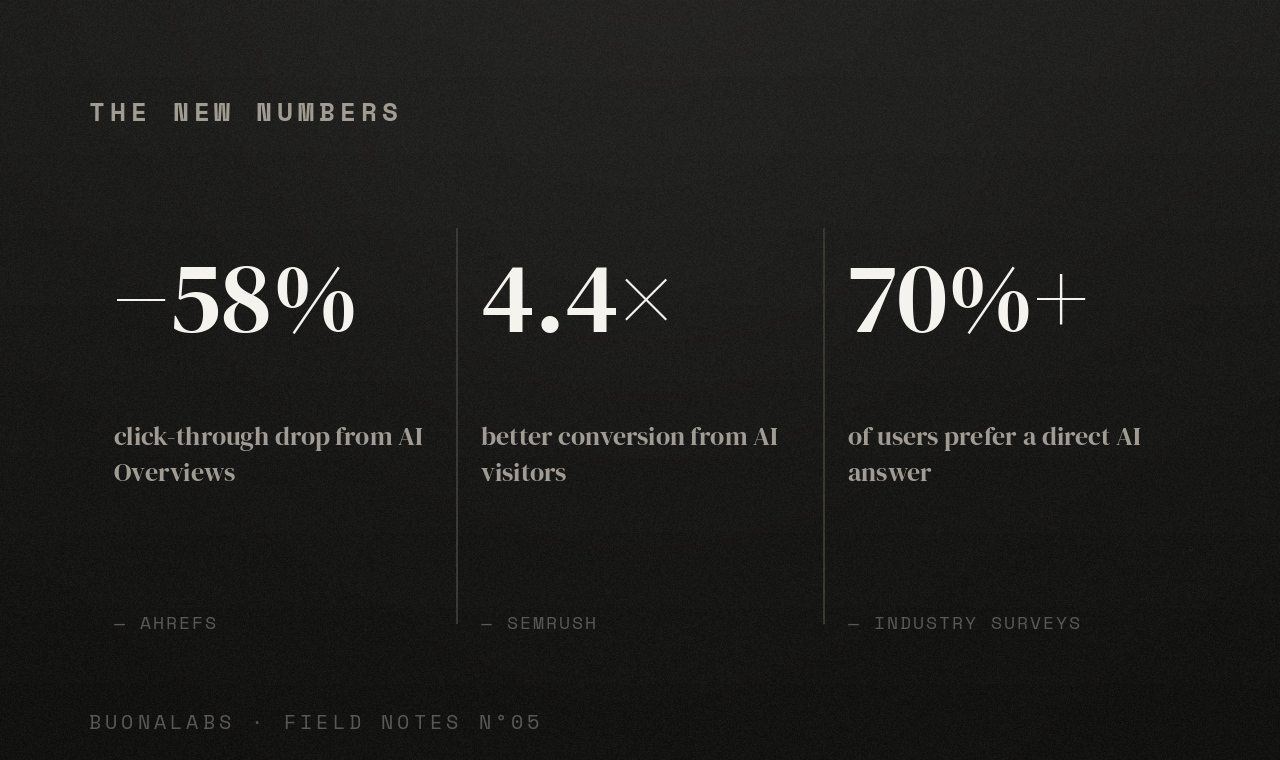
Ahrefs found that Google's AI Overviews cut click-through rates for top-ranking content by around 58% — the answer now sits on the results page, so there's nothing to click.
Surveys find that over 70% of users now prefer a direct AI answer to scrolling through links.
ChatGPT alone processes on the order of 2.5 billion prompts a day, a large share of them effectively searches.
The behavior has already moved.
The uncomfortable implication: ranking number one on Google no longer guarantees you'll be seen.
You can win the old game perfectly and still be invisible in the answer the AI gives your customer.
If your content isn't legible to the machine, your brand simply isn't in the room when the decision gets made.
Meet your second audience
So who is this new reader, and what does it want?
It helps to understand what it can't do.
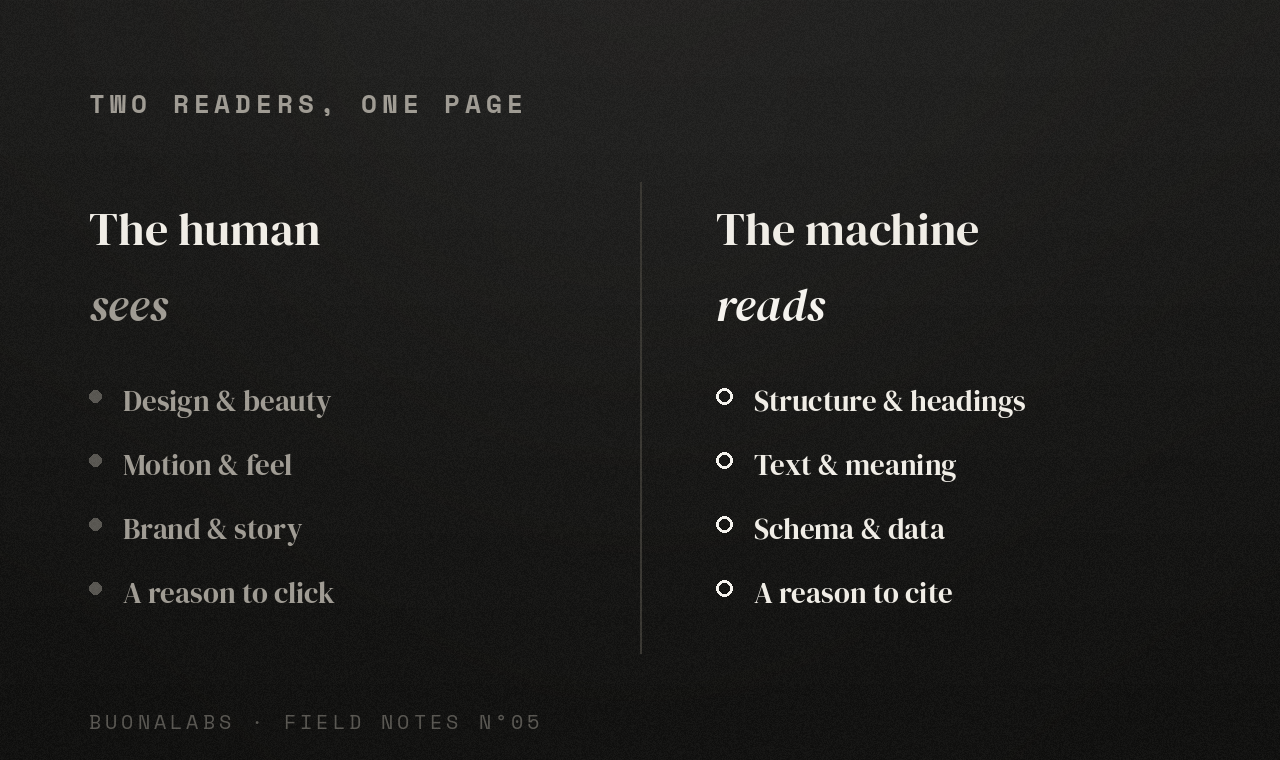
The machine cannot appreciate your beautiful design.
It doesn't feel your brand.
It can't watch your hero animation, admire your color palette, or be moved by your photography.
It reads structure, text, and meaning — and almost nothing else.
It wants content that is easy to parse, clearly organized, factually dense, and obviously trustworthy.
This is where a lot of modern, design-forward sites quietly fail.
If your key content is rendered entirely by JavaScript in the browser, locked behind a login or a "load more," or baked into images with no text alternative, then to the machine reading on your customer's behalf, that content may as well not exist.
The human sees a stunning site.
The machine sees a blank page — and leaves you out of the answer.
(This matters especially for sites built on modern frameworks like React or Next.js, where content can end up invisible to crawlers unless it's deliberately rendered server-side.)
The counterintuitive good news
Here's the part that flips the doom narrative: AI traffic is better traffic.
Yes, you get fewer clicks.
But the clicks you do get are higher quality, because the AI has effectively pre-qualified the visitor — answering their early questions and sending them to you when they're closer to acting.
Semrush found that visitors arriving from LLMs convert around 4.4x better than traditional search traffic.
Vercel reported that roughly 10% of its new signups were coming from ChatGPT referrals.
Fewer, warmer, more decided visitors.
And even the no-click outcomes have value.
When an AI cites your business as a source — or simply mentions you as the answer — that's brand presence in front of someone at the exact moment of intent, whether or not they click.
The metric of success is shifting from clicks to citations: being the source the machine trusts enough to name.
A warning about the snake oil
Now the honest part, because this space has become a gold rush and most agencies won't tell you this.
A whole vocabulary has sprung up overnight — GEO, AEO, LLMO — along with a market of consultants selling "AI-specific" files and markup as if they were secret keys.
The most-hyped is llms.txt, a proposed file you place at your site's root to tell AI systems what you're about.
It sounds essential.
But in May 2026, Google published its own guidance and was blunt: for Google Search, you can ignore llms.txt, special schema, content "chunking," and AI-specific rewriting.
In Google's framing, optimizing for AI is still just SEO done well — not a separate dark art.
So who's right? Both, partly.
llms.txt is cheap to add and may help some non-Google engines, so it's reasonable as low-cost insurance — but anyone selling it to you as the thing that will transform your AI visibility is selling hype.
The uncomfortable, unglamorous truth is that the things that actually move the needle are the same things that have always defined a good website:
clarity, structure, speed, and substance.
There is no hack.
There's just craft.
What actually works — for both readers
The beautiful thing is that almost everything that makes your site legible to the machine also makes it better for the human.
You're not building two sites. You're building one good one.
The essentials:
- Don't accidentally block the AI crawlers.
Check your robots.txt, and check that your CDN (Cloudflare especially) isn't silently rejecting AI bots. Step one is simply being readable. - Render your important content server-side.
If it only appears after JavaScript runs, assume the machine can't see it.
This is the single most common technical failure on modern sites. - Don't hide what matters behind logins, pop-ups, or text-in-images.
- Structure for scanning.
Clean heading hierarchy, one idea per section, and lead each section with a direct answer before the context.
(Useful for skim-reading humans, essential for machines.) - Add structured data (schema) for things like products, FAQs, reviews, and your organization — it tells the machine exactly what each thing is.
- Publish things worth citing.
Original data, real expertise, and specific answers earn citations; generic filler doesn't. This is where being genuinely good beats every trick. - Keep it fresh.
AI engines weight recency.
Update cornerstone pages and show a "last updated" date. - Be mentioned elsewhere.
LLMs lean heavily on third-party sources, so reviews, directories, and press about you feed your visibility as much as your own pages do. - Be fast.
Speed and accessibility help humans and machines alike — a topic worth its own piece.
How to tell it's already happening to you
You don't have to guess whether the shift has reached your business — the evidence is probably already in your own dashboard.
Open Google Search Console and look for pages where your impressions held steady but your click-through rate quietly fell over the last year.
That gap is the tell: the same number of people are seeing you in search, but fewer are clicking, because an AI answer is satisfying them before they reach you.
It's the fingerprint of the change, hiding in data you already have.
This is why measuring success purely by clicks is becoming a trap.
Marketers have started talking about the "decoupling of clicks from impact" — the reality that your brand can influence a buying decision through an AI answer without ever registering a single visit.
The businesses adapting fastest are the ones learning to value being named by the machine, not just clicked by the human.
A mention you can't measure is still a mention that shaped the decision.
The deeper point
Notice that none of that list is a gimmick. "Optimize for AI" turns out to be almost identical to "build an excellent website."
A site that's fast, cleanly structured, server-rendered, substantive, and trustworthy serves the human reader and the machine reader at the same time.
A site that's slow, tangled, hidden behind scripts, and thin on substance loses both — it just used to only lose the half you could measure.
That's the reframe worth keeping: the machine audience didn't add a new set of rules.
It raised the cost of the ones we were always supposed to follow.
How we think about it at BuonaLabs
We build sites to be legible to both readers from the architecture up — content rendered so crawlers can read it, structure that's clean for a skimming human and a parsing model alike, speed and accessibility as defaults, and substance worth citing.
Not an "AI SEO package" bolted on after launch, but the right foundations laid before it.
We'll happily add the cheap AI-specific touches where they help — and we'll tell you honestly which ones are theater.
Your customer is still a human.
But they're going to meet a machine first.
Build a site that earns the trust of both, and you stay in the answer.
Build one that only flatters the eye, and you may find that, increasingly, no one is being shown the door to you at all.
Two audiences. One website. Make it speak to both.