
The Real Cost of a Slow Website

The most expensive thing on your site isn't a line item you can see.
It's the visitors who left before the page loaded — and you'll never know their names.
What slowness actually costs in 2026, and why it became a coding problem, not a hosting one.
You launch a beautiful new website. The design is sharp, the photography is gorgeous, the copy is tight. You're proud of it, and you should be.
What you can't see is this: on mobile, where most of your traffic lives, a large share of visitors are already gone before your hero image finishes loading.
They didn't complain. They didn't email.
They tapped, waited a beat too long, and left — and they will never appear in any report as a problem, because to your analytics they barely existed at all.
That is the real cost of a slow website.
Not the annoyance you feel waiting for your own page.
The revenue that quietly walks out a door you didn't know was open.
The invisible tax on everything
Speed's effect on money is one of the most thoroughly measured relationships in all of digital business, and the numbers are unforgiving.
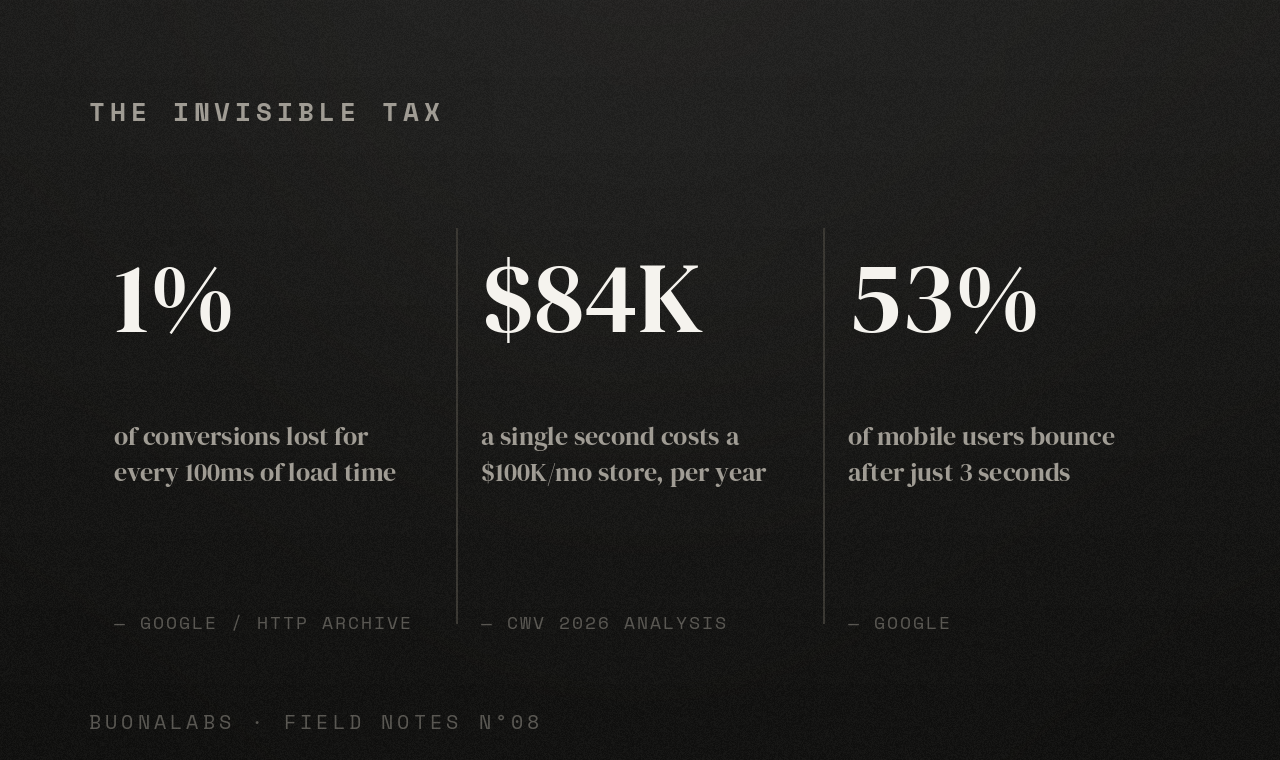
Aggregated across thousands of sites, roughly every 100 milliseconds of load time costs about 1% of conversions.
A full second of delay reduces conversions by around 7%, cuts page views by about 11%, and drops customer satisfaction by roughly 16%.
Put that in currency.
For an online store doing $100,000 a month, a single extra second of load time works out to about $84,000 in lost revenue per year — for one second.
Scale it up and it gets absurd: for a site doing $10 million annually, shaving just 500 milliseconds can recover on the order of $500,000.
A site that loads in one second converts at roughly three times the rate of one that takes five, and five times the rate of one that takes ten.
Meanwhile, patience has collapsed.
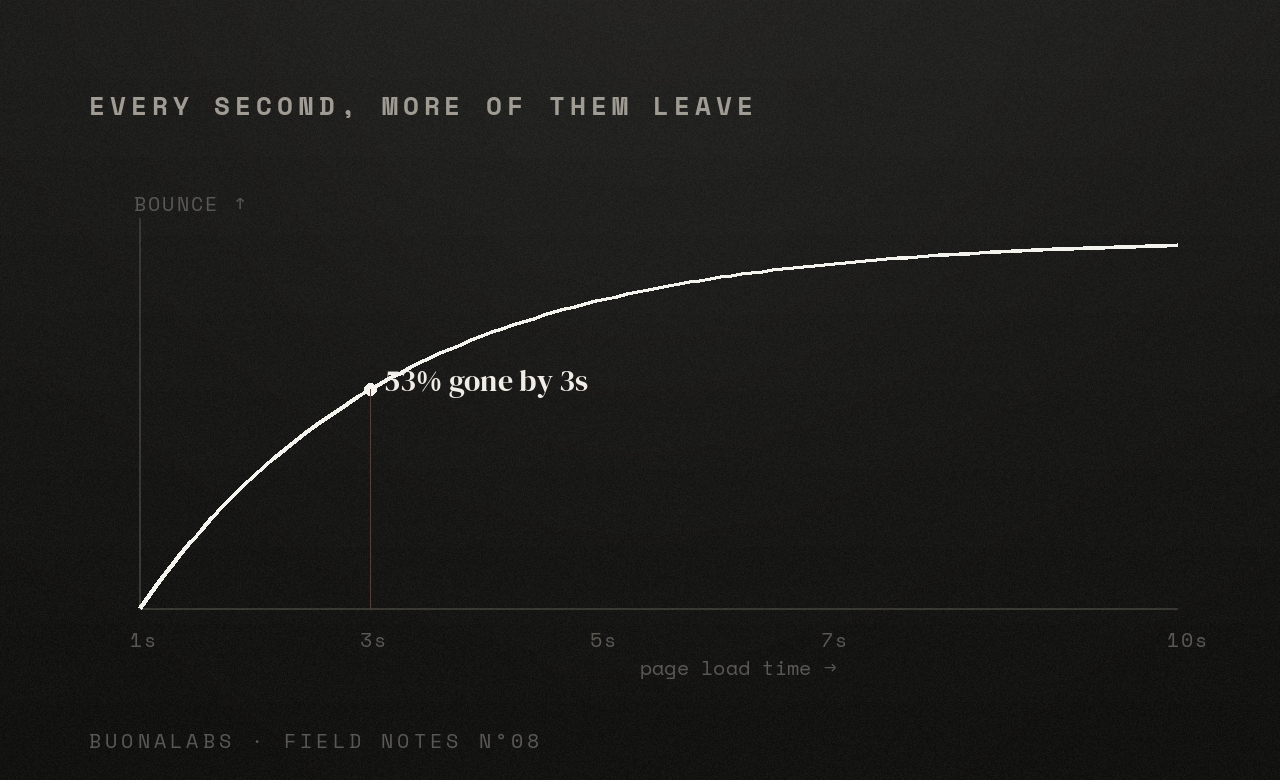
53% of mobile users abandon a site that takes longer than three seconds to load — and the average mobile page still takes around 8.6 seconds.
Sit with that gap.
More than half your mobile audience has a three-second fuse, and the typical page burns nearly nine.
The math isn't subtle.
Why you can't feel it
Here's what makes slowness so dangerous: it's the rare business problem that generates almost no visible evidence.
A broken checkout throws errors. A rude employee gets a complaint.
But a visitor who bounces because your page was slow simply vanishes.
They don't file a ticket.
They often leave before your analytics script even loads, so they don't fully register in your numbers.
The people most damaged by your slow site are, by definition, the ones you can't see and never hear from.
That invisibility is exactly why speed gets neglected.
It doesn't scream.
It just quietly skims a percentage off everything you do — every ad you run sends traffic to a leaky page, every SEO win pours visitors into a funnel that drops them at the door.
The cost compounds silently, which is the most expensive kind of cost there is.
2026 raised the stakes
If the revenue argument weren't enough, Google tightened the screws this year.
The March 2026 core update lowered the "Good" threshold for Largest Contentful Paint from 2.5 seconds to 2.0, instantly reclassifying a swath of previously-passing pages as needing improvement.
It also elevated Interaction to Next Paint (INP) — the metric for how fast your page responds when someone taps — to an equal, primary ranking signal.
Sites with slow loading saw average ranking drops of two to four positions on competitive queries.
Translate that: speed no longer just costs you the visitors who arrive.
It increasingly determines whether they arrive at all, because a slow site ranks lower and fewer people ever see it.
Combine that with the reality that a majority of traffic is now mobile-first, and performance has quietly become one of the highest-leverage things you can fix — it moves conversion and traffic at the same time.
Slow feels like broken
There's a softer cost that doesn't show up in a spreadsheet but shapes every sale: trust.
A slow site feels cheap, neglected, and faintly broken, no matter how premium the design.
Users read sluggishness as incompetence — if the company can't make its own website work smoothly, what else can't it do?
In high-stakes categories especially — finance, healthcare, anything where someone is deciding whether to trust you with money or data — a slow, janky page erodes confidence before a single word is read.
Speed is perceived competence.
Layout that jumps around while loading (the third Core Web Vital, Cumulative Layout Shift) makes it worse: people tap the wrong thing and feel the site is fighting them.
The three numbers Google actually watches
It's worth knowing the scoreboard, because it's refreshingly concrete.
Google's Core Web Vitals boil the entire experience down to three measurable things.
Largest Contentful Paint (LCP) is loading — how long until the main content actually appears; the 2026 "good" bar is now 2.0 seconds.
Interaction to Next Paint (INP) is responsiveness — how quickly the page reacts when someone taps or clicks; good is under 200 milliseconds.
Cumulative Layout Shift (CLS) is stability — how much the page jumps around as it loads; good is under 0.1.
Loading, responsiveness, stability. That's it.
And most of the web is failing: depending on the dataset, only around a third to 42% of sites pass all three on mobile — which means this is one of the few places left where getting the fundamentals right is still a genuine competitive advantage, because so many of your competitors haven't.
The myth that it's a hosting problem
Here's the part most people get wrong, and it matters enormously.
When a site is slow, the instinct is to blame the server and buy a bigger hosting plan.
In 2026, that's usually the wrong fix.
The bottleneck has moved from the network to the device.
The slow part is no longer mainly about how fast bytes travel — it's about how much work the visitor's phone has to do once they arrive: executing JavaScript, rendering the page, responding to taps, keeping the layout stable.
As the performance community now puts it plainly, speed in 2026 is primarily a coding discipline, not an infrastructure one.
You cannot buy your way out of a two-megabyte JavaScript bundle with a faster server.
This is precisely where design-forward and template-heavy sites fall down.
Bloated page builders, dozens of plugins, oversized images, and mountains of unused code produce sites that look stunning and perform terribly — beautiful liabilities.
It ties directly back to a theme we keep returning to: a gorgeous site that loads slowly isn't a design win.
It's a business problem wearing a nice outfit.
What actually moves the needle
The good news is that the highest-impact fixes are well understood, and most sites are leaving easy wins on the table.
Roughly in order of payoff:
- Images first. Images are typically over half of a page's weight. Serving modern formats (WebP, AVIF), compressing properly, lazy-loading below-the-fold media, and setting explicit dimensions is the single biggest, cheapest speed win available — often 25–35% faster on its own.
- Put the JavaScript on a diet. Ship less code, split it so pages only load what they need, defer what isn't critical, and render meaningful content on the server so it appears fast. This is where the real 2026 battle is won or lost.
- Move work to the edge. A CDN and edge computing (Cloudflare, Vercel and similar) serve content from close to the user, cutting server response time dramatically — good caching and HTTP/3 compound the effect.
- Preload fonts and stabilize the layout. Small touches that remove the stutter and the jumping.
- Measure real users, not just lab tests. Your Google Search Console Core Web Vitals report and field data show what actual visitors experience — start there, fix the worst pages first.
Why this is the best money you'll spend
Because the cost of slowness is invisible, the return on fixing it feels almost too good.
Performance work commonly delivers 300–500% first-year returns, with payback measured in weeks, not years.
And the case studies are not hypothetical: Rakuten improved its loading metric and saw a 53% increase in revenue per visitor; Vodafone improved loading by 31% and gained 8% more sales; Ray-Ban prerendered key pages and more than doubled mobile product-page conversions; Walmart found every one-second improvement lifted conversions by 2%.
These are the same fixes described above, turned into revenue.
Speed is a growth lever disguised as a technical chore.
That disguise is exactly why the companies willing to look past it win.
How we think about it at BuonaLabs
We build performance in from the first line, not bolted on before launch.
That means architecting for speed, rendering content server-side so it appears instantly and is legible to both people and search engines, keeping JavaScript lean, serving from the edge, and treating Core Web Vitals as a requirement rather than a nice-to-have.
Fast isn't a setting we flip at the end — it's a consequence of how the thing is built.
The visitors you lose to a slow site are the ones you'll never meet, never market to, never win back.
They're the most expensive customers you'll ever have, precisely because you never had them.
Fix the speed, and you don't just keep them — you rank higher, convert more, and feel more trustworthy than every competitor who decided a slow, beautiful site was good enough.
It never was.
In 2026, fast is the feature.