
We Rendered This Product Before It Existed

The photo isn't a photo.
The product in it may never have been manufactured.
Why 3D visualization quietly became the most powerful tool in commerce — and the one place a camera still wins.
Look at a product image on almost any premium furniture or electronics site today. Crisp edges, perfect light, the material rendered so faithfully you can almost feel it.
Now consider: there's a good chance no camera was ever involved.
There's an even more interesting chance that, at the moment the image was made, the product itself did not physically exist — no factory had produced it, no sample had been shipped, no photographer had ever touched it.
That's not a trick. It's the quiet revolution in how products get shown, sold, and even decided — and most shoppers have no idea it's already happened.
The realism debate is over
For years, the argument against 3D rendering was simple: it looks fake.
That argument is finished.
Modern physically-based rendering reproduces material, texture, light, and shadow to a level that is genuinely indistinguishable from photography in normal viewing conditions.
The proof is hiding in plain sight: IKEA has produced roughly 75% of its catalog imagery as CGI for years, and customers don't notice.
You have almost certainly bought something based on a rendered image and believed you were looking at a photo.
So the interesting question is no longer "can it look real?" It clearly can.
The question is what rendering lets you do that a camera never could — and that's where it stops being a cheaper way to make product photos and becomes a different kind of power entirely.
The superpower: content unchained from physical reality
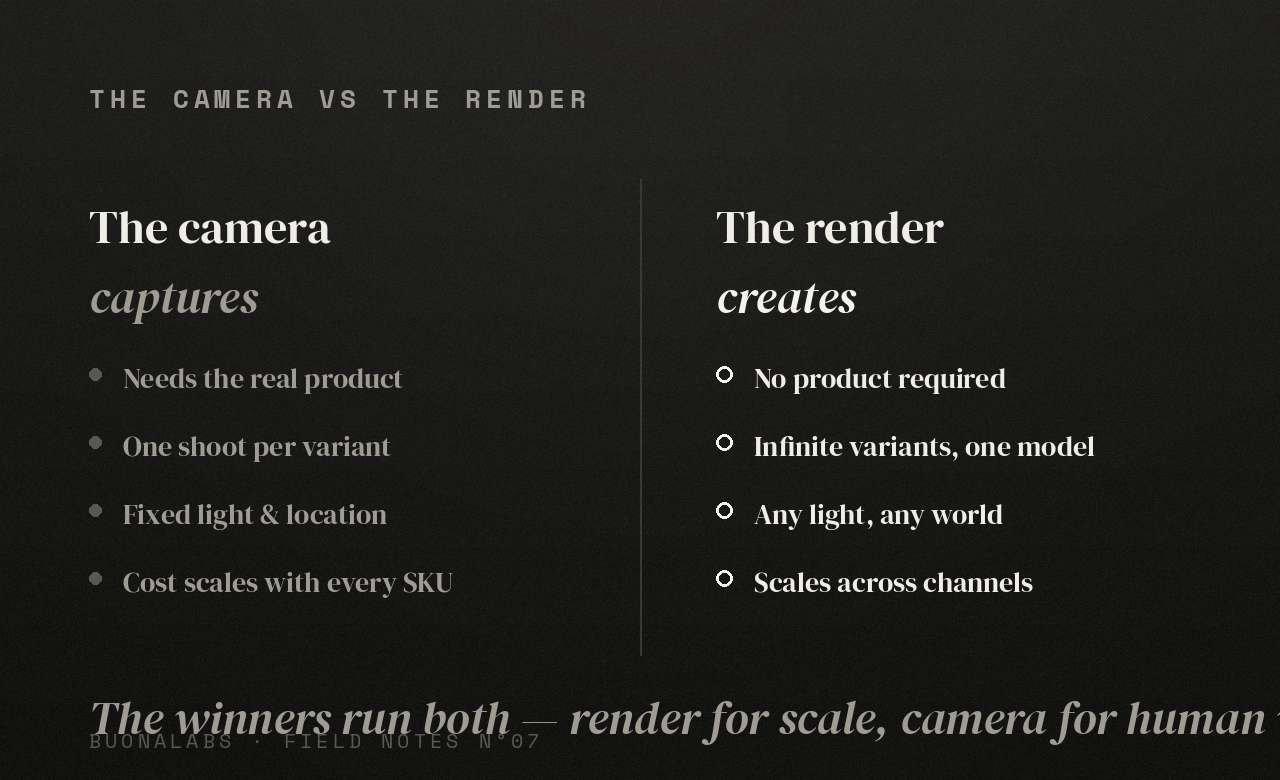
A camera can only photograph what already exists, where it exists, under the light that happens to be there.
A render has none of those limits.
That single difference cascades into everything.
You can visualize a product before it's manufactured — turning a CAD file or a concept into photorealistic imagery months before the first unit comes off a line.
That means you can market it, pre-sell it, gather feedback on it, and make design decisions about it while it's still changing.
Should the handle be brushed steel or matte black? Render both, put them in front of customers, and decide with evidence instead of a hunch — before you've committed a cent to tooling.
You can place it anywhere: a sofa in a sunlit Scandinavian loft, then a dim evening lounge, then a summer garden — no location scouting, no set construction, no reshoots when the season changes.
You can show it in any variant: every colorway, every fabric, every finish, every size, all from one model.
The product becomes data, and data bends to whatever the story needs.
This is why the framing "3D vs. photography" undersells it.
It's not a substitute for a photo.
It's the ability to photograph the impossible.
The scale math is the real ROI
Here's where the finance team leans in.
Imagine a sofa offered in 47 fabrics, across 6 leg finishes, in 3 sizes, needed for your website, your marketplace listings, your in-store kiosks, and your trade catalog.
Photography's answer to that is brutal: organize dozens of photoshoots, and repeat the exercise every time you add a variant or a channel.
Cost scales linearly and painfully with your catalog.
3D's answer is different: build one accurate archetype, then render every variant and every scene from it, at a fraction of the marginal cost.
The numbers brands report are not subtle — production cost reductions of up to 70%, photoshoot volume cut by around 80%, and consistent hard savings (one furniture brand, Riverside, reports saving roughly $100,000 a year).
And because every asset descends from the same master, your imagery is perfectly consistent across web, Amazon, ads, and retail — no more mismatched lighting from six different shoots signaling a lack of rigor to the customer.
The right comparison was never "one render vs. one photo."
It's the total cost of producing all your visual content, across every variant and channel, over the life of the catalog.
On that comparison, it isn't close.
There's a speed and waste dividend on top of the money.
No sample shipping, no set construction, no location travel, no reshoots when a detail changes — which means faster time-to-market and a markedly smaller footprint per launch.
You can render a full seasonal drop while the physical samples are still in transit, and adjust a colorway the afternoon someone changes their mind, not three weeks later after another shoot.
It doesn't just cost less. It sells more.
If rendering only saved money, it would be a procurement decision.
What makes it a growth decision is what it does to conversion.
The mechanism is simple: online shopping has an information gap — you can't pick the thing up.
Interactive 3D closes that gap.
When a customer can rotate a product 360 degrees, zoom into the stitching, swap the color in real time, or drop it into their own living room through AR, their uncertainty collapses and their confidence rises.
Confidence is what converts.
The data backs it hard.
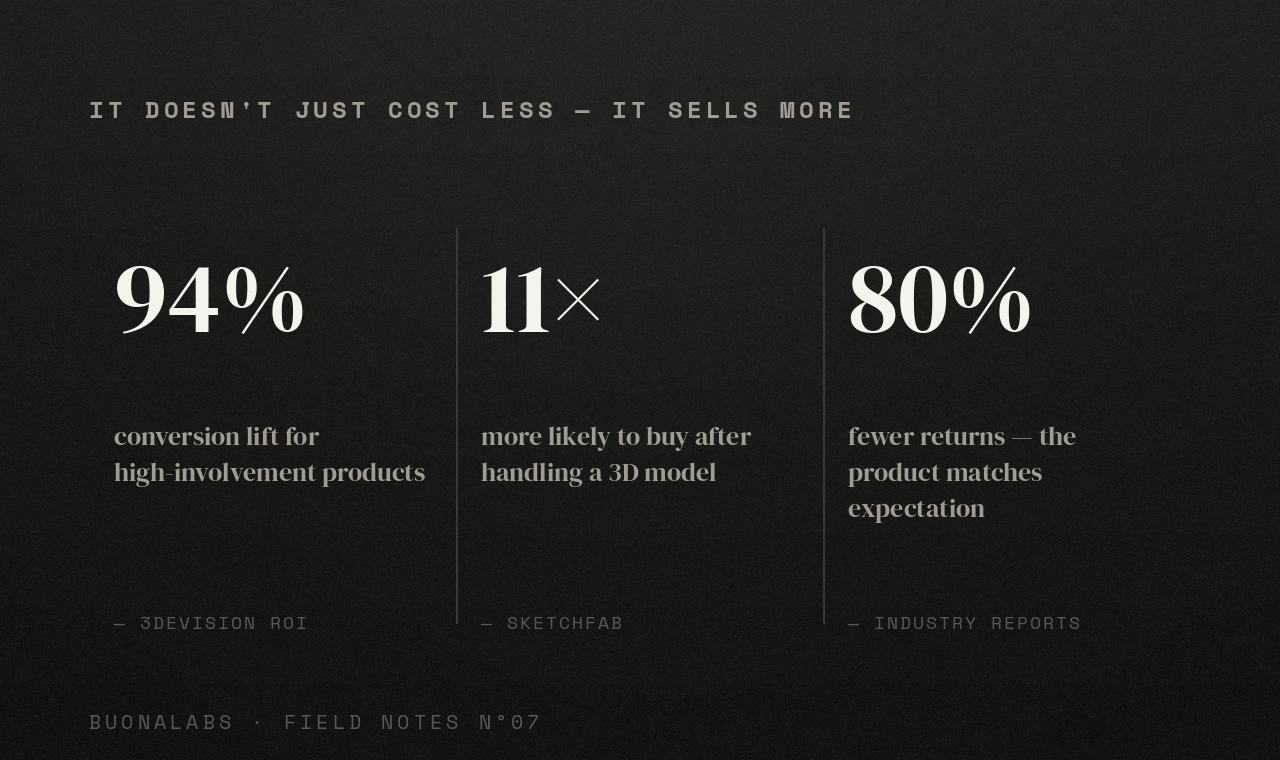
Brands implementing 3D visualization commonly report conversion lifts of 20–40%, climbing to as much as 94% for high-involvement products like furniture.
Sketchfab found shoppers were 11x more likely to purchase after interacting with a 3D model.
Returns — the silent margin-killer of e-commerce — drop by up to 80%, because the product that arrives matches the one the customer thoroughly explored.
Average order values rise too.
When the product page stops being a flat photo and becomes something the customer operates, the whole economics of the sale shift.
The product page stops being a page
There's a second-order effect worth naming.
Once the product is a 3D model rather than a set of flat photos, the product page itself can change from something you read into something you use.
The hero image becomes a live configurator: choose the finish, watch it update instantly, see the price move with it, then tap "view in AR" and stand the actual object in your own room through your phone.
That matters more than it sounds, because over 60% of product browsing now happens on mobile, and AR turns the one thing mobile shoppers can't do — judge scale and fit — into a two-second check.
Every uncertainty you remove between "interested" and "buy" is money.
A configurator that answers "what will mine look like, and will it fit?" in real time is doing conversion work that no gallery of photographs, however beautiful, can match.
Where the camera still wins
Now the honest part, because anyone selling you "replace all your photography" is overselling.
Rendering is not a universal answer, and the smartest brands don't treat it as one.
Human warmth still belongs to photography.
The lifestyle shot with real people laughing on the sofa, the genuine texture of a lived-in moment, the emotional storytelling of a brand campaign — these are where real cameras and real humans remain unbeaten, and a render can feel sterile trying to fake them.
Certain tricky materials — a foaming pour, a translucent gel — sometimes still photograph better than they render.
And the upfront cost of building that first accurate 3D archetype is real; it's more expensive than a single photo, and it only pays off when amortized across many variants and uses.
So the winning play in 2026 isn't "3D instead of photography." It's a hybrid: rendering for product detail, configuration, AR, dimension shots, endless variants, and scale — and photography for human context, emotion, and brand storytelling.
Use each for what it's genuinely best at.
The bigger shift: from a photo library to a digital twin
Step back and the deepest change becomes clear.
When you commission photography, you're buying images — a fixed library that's already slightly out of date the moment your product line changes.
When you build in 3D, you're creating a digital twin: a physically accurate virtual version of your product that becomes the single source for everything downstream.
Stills, 360 spins, animations, AR try-on, real-time configurators, social content, and AI-assisted variations all flow from that one asset.
You're no longer buying pictures.
You're building an asset that keeps paying out — one that's ready for channels and experiences that don't fully exist yet.
That's a fundamentally better position to be in as commerce keeps moving toward the interactive and immersive.
How we think about it at BuonaLabs
3D and rendering sit right at the center of what we do, and we approach it as a system, not a service: build the accurate digital twin, then let it feed your entire visual pipeline — photorealistic stills, interactive configurators, AR, and animation — with real photography layered in exactly where human warmth belongs.
The goal is to help you launch faster, spend less producing visuals, and convert more because customers can truly experience the product before it arrives.
A camera captures what exists.
Rendering captures what you intend — often before it's even real.
That's not a better photo.
It's a different power, and the brands that understand the difference are the ones designing the next few years of commerce instead of just photographing the last few.
We rendered this product before it existed.
The only question worth asking is what you'll render before yours does.