
Personalization vs. Creepy

Shoppers demand to feel understood — and walk away from brands that feel like surveillance.
The line between the two isn't how much you know about them.
It's where the data came from, and why you're using it.
You know the feeling.
You browse a pair of shoes once, don't buy, and for the next three weeks those exact shoes stalk you across every website you visit.
Or you get an email that references something you never told the brand — something it clearly inferred — and a small chill goes down your spine: how did they know that?
That reflex, the one that turns a customer cold in half a second, is now one of the most underrated business risks in e-commerce.
Here's the trap modern brands are caught in: shoppers punish you for personalizing too little, and abandon you for personalizing the wrong way.
Getting this line right isn't a nice-to-have.
It's the difference between a customer who feels understood and one who feels watched.
You can't not personalize
Let's dispense with the idea that playing it safe means personalizing less.
The expectation is now baked in.
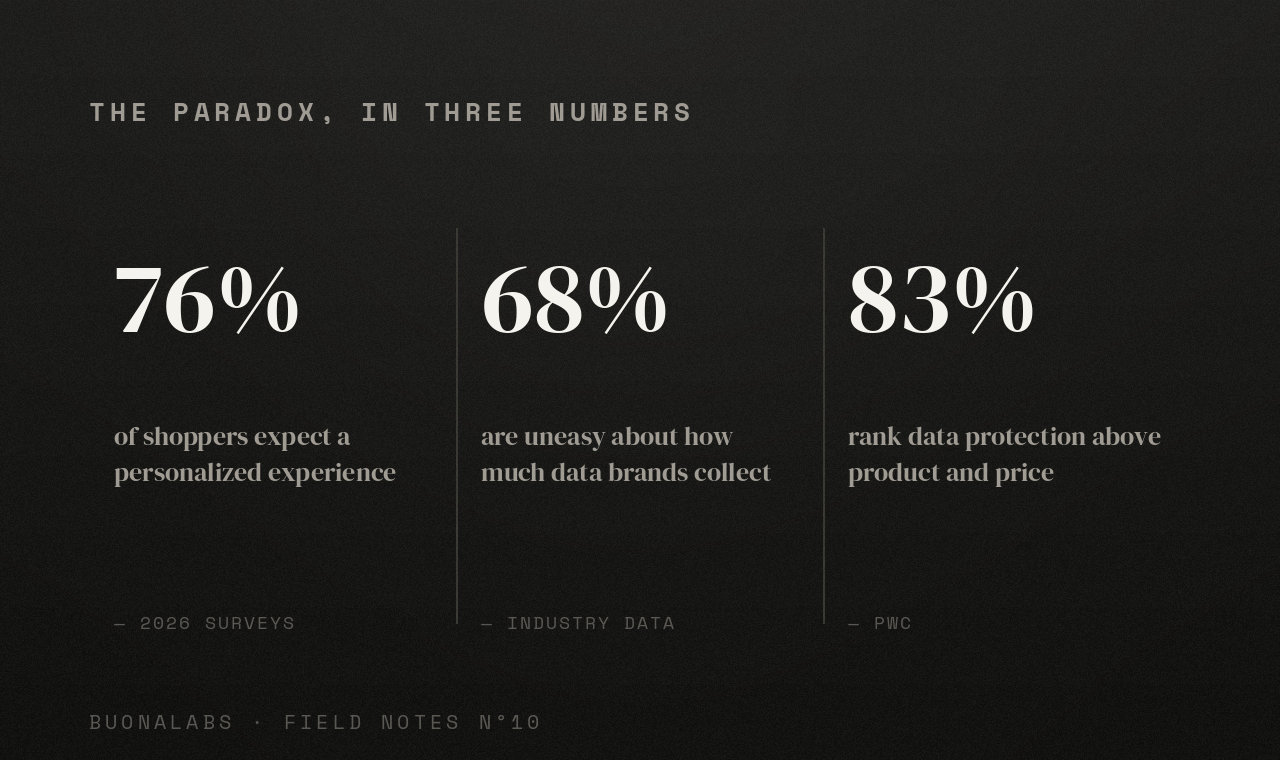
Around 76% of consumers expect personalized experiences, roughly 71% feel actively frustrated when personalization is missing, and about 62% say they lose loyalty to brands that don't deliver it.
On the upside, personalization drives somewhere between 5% and 25% of total revenue depending on the industry, and personalized product recommendations alone account for a quarter to a third of e-commerce revenue at many retailers.
Show every visitor the identical generic storefront and you don't read as "safe and respectful" — you read as a brand that can't be bothered to notice them, which (as we've written about the wider web) increasingly feels like a brand that isn't really there.
Doing nothing is not the cautious option.
It's just a different way to lose.
…but it can blow up in your face
Now the other jaw of the trap.
That same data-hungry personalization, done carelessly, is one of the fastest ways to destroy trust — and trust, it turns out, matters more than personalization ever will.
Roughly 68% of consumers are uneasy about the sheer volume of data companies collect.
Nearly two-thirds don't believe companies are honest about how they use it.
And the consequences are not abstract: privacy concerns have driven close to half of all consumers to abandon a brand entirely — a churn rate that outpaces losses from price or product problems.
When Segment asked shoppers what matters most in choosing a brand, only 10% picked personalization; 55% picked trustworthiness and transparency.
Perhaps most humbling of all: only about 48% of consumers think brands do personalization well.
Most companies are simultaneously personalizing too little and too creepily, and overrating themselves at both.
So the task isn't "personalize more" or "personalize less."
It's to understand exactly where the line between helpful and creepy actually runs — because it's not where most brands think.
Where the creepy line actually is
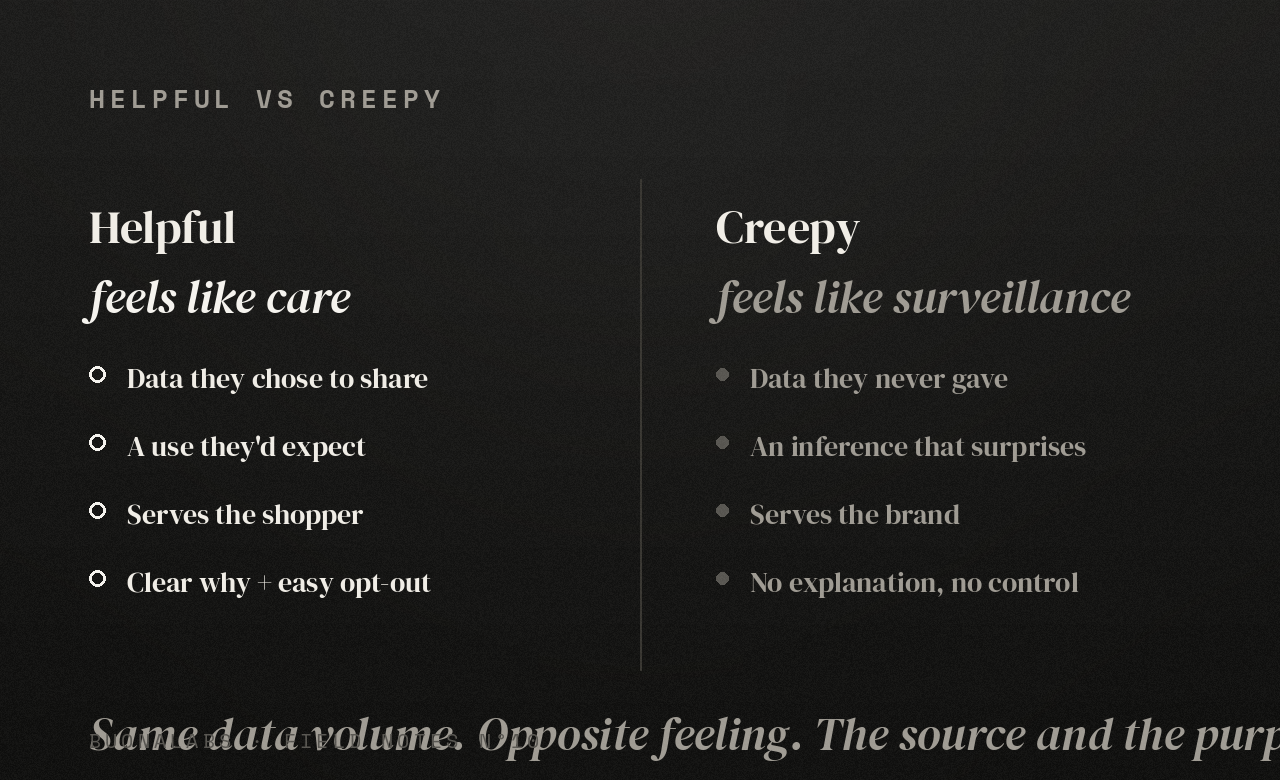
Here's the key insight, and it's liberating once you see it: creepiness has almost nothing to do with how much you know. It has everything to do with the source of the data, the surprise of the inference, who it serves, and whether the person has any control.
Personalization feels helpful when it uses data the customer knowingly gave you, for a purpose they'd naturally expect, in a way that visibly serves them, with an obvious way to adjust it.
"You bought this printer; here's the ink it takes." Nobody is creeped out by that.
Personalization feels creepy when it uses data they didn't realize they were handing over, to reveal an inference they didn't expect you to make, in a way that serves you more than them, with no explanation and no off-switch.
The infamous cautionary tale — a retailer deducing a shopper's pregnancy from her buying patterns and marketing to her before she'd told her own family — is the canonical example.
The problem was never the accuracy.
It was that the brand knew something intimate she never chose to share, and revealed that it knew.
The most useful reframing floating around expert circles in 2026 captures it perfectly: personalize experiences, not identities.
Adapt to what someone is doing right now — the context, the behavior, the moment — rather than assigning them a fixed label or making sensitive inferences about who they are.
The first feels like good service.
The second feels like being profiled.
2026 quietly settles the argument for you
If the ethics weren't persuasive enough, the ground is shifting under the creepy playbook anyway — and fast.
The third-party cookie, the engine of "follow them everywhere and buy data about them from strangers" personalization, is being restricted into irrelevance.
Meanwhile, 144 countries now have data-protection laws, covering something like 79% of the world's population, and the regulatory direction is only tightening.
The invasive approach isn't just becoming distasteful; it's becoming illegal and technically obsolete at the same time.
That sounds like a constraint.
It's actually a gift, because it forces every brand toward the approach that was always better anyway.
The better path: data they give you
The winning model in 2026 rests on data the customer is a willing partner in, not a target of.
Zero-party data is information people hand you deliberately and happily — through a style quiz, a fit finder, a preference center.
When Sephora asks a few questions to recommend the right shade, no one feels surveilled; they feel served, because they chose to answer.
First-party data is the relationship you actually have — their purchases, their behavior on your own site — unified into a single, honest view.
And contextual signals — location, weather, time of day, what they're looking at right now — let you stay relevant without holding any sensitive profile at all, preserving much of the conversion lift with almost none of the risk.
The quiet punchline: this consented, first-party approach isn't just more ethical and more compliant.
It's often more accurate, because data someone gives you on purpose beats data you guessed.
The right thing and the effective thing have converged.
And people are genuinely willing partners when the deal is fair: around 83% of consumers say they'll share data themselves in exchange for a better experience.
The willingness was never the problem.
The problem was taking data they didn't offer, for purposes they didn't sanction.
Ask openly, explain the benefit, and most people say yes — which means the "we had to be creepy to compete" excuse was never true.
The rules of non-creepy personalization
Translated into practice, a handful of principles keep you on the right side of the line:
- Personalize with purpose, not curiosity. Collect the minimum you need for a benefit the customer would recognize — not everything you can, just because you can.
- Be transparent. About 77% of shoppers trust a business more when data use is clearly explained. A plain-language "why am I seeing this?" next to a recommendation isn't legal boilerplate; it's a trust-builder.
- Trade value for data, openly. People share willingly when they can see what they get back. Make the exchange visible and fair.
- Give control. Easy preferences, easy opt-out. Control is the antidote to creepiness; people forgive a lot when they feel they're holding the wheel.
- Never reveal you know more than they told you. If using a piece of data would make the customer ask "wait, how do you know that?", don't.
Trust is the actual feature
Step back and the strategic picture is clear.
In a landscape where 83% of consumers rank data protection above product quality and price as a driver of trust, and 81% treat how you handle their data as a proxy for how much you respect them, being visibly trustworthy with data isn't a compliance chore.
It's a competitive advantage — arguably the competitive advantage — and a genuine loyalty engine.
Privacy concerns grow in the dark.
Trust is built in the light.
The brand that personalizes with obvious respect, from data freely given, will beat the data-hungry competitor who knows more but is trusted less — every time it matters.
How we think about it at BuonaLabs
We build personalization and e-commerce experiences that are effective because they're trustworthy, not in spite of it: consent-first data foundations, transparent on-site modules that tell people why they're seeing something, first- and zero-party data instead of bought profiles, and privacy engineered into the architecture rather than bolted on to survive an audit.
The result is personalization that lifts revenue and deepens loyalty at the same time — because it makes customers feel understood, never surveilled.
That distinction — understood, not surveilled — is the whole game.
The goal was never to know everything about your customer.
It was to make them feel known in a way that feels like care, not surveillance.
Get the source and the purpose right, and personalization stops being a risk you manage and becomes the reason people stay.
This is the final entry in our Field Notes series — ten pieces on design, AI, security, speed, and craft.
If there's a thread running through all of them, it's this: the durable advantage in a noisy, automated, AI-saturated market is trust — earned by being distinctive, honest, secure, fast, and genuinely useful.
That's the whole business.