

Why Hackers Now Prefer Small Businesses

"We're too small to be a target" was always a comforting lie. In 2026 it's a dangerous one — because AI and rented ransomware flipped the economics, and being small no longer makes you safe. It makes you easy.
A boutique marketing agency in Austin — fewer than 15 people, no IT department — noticed their systems freeze one afternoon.
They assumed it was a glitch.
Within 24 hours they understood: ransomware had quietly encrypted everything, and the attacker wanted $25,000 in crypto.
With no backups they could trust and no one on staff who knew what to do, they paid.
They're one of thousands of stories that never make the news, because small businesses getting hacked isn't a headline. It's a Tuesday.
For years, the comforting story owners told themselves was that hackers go after the big fish — the banks, the retailers with millions of card numbers, the names worth a ransom.
Small companies were beneath notice.
That belief is now not just wrong; it's precisely backwards.
Small and mid-sized businesses aren't the ones who slip through.
In 2026, they're the main event.
The numbers that kill the myth
The data is blunt.
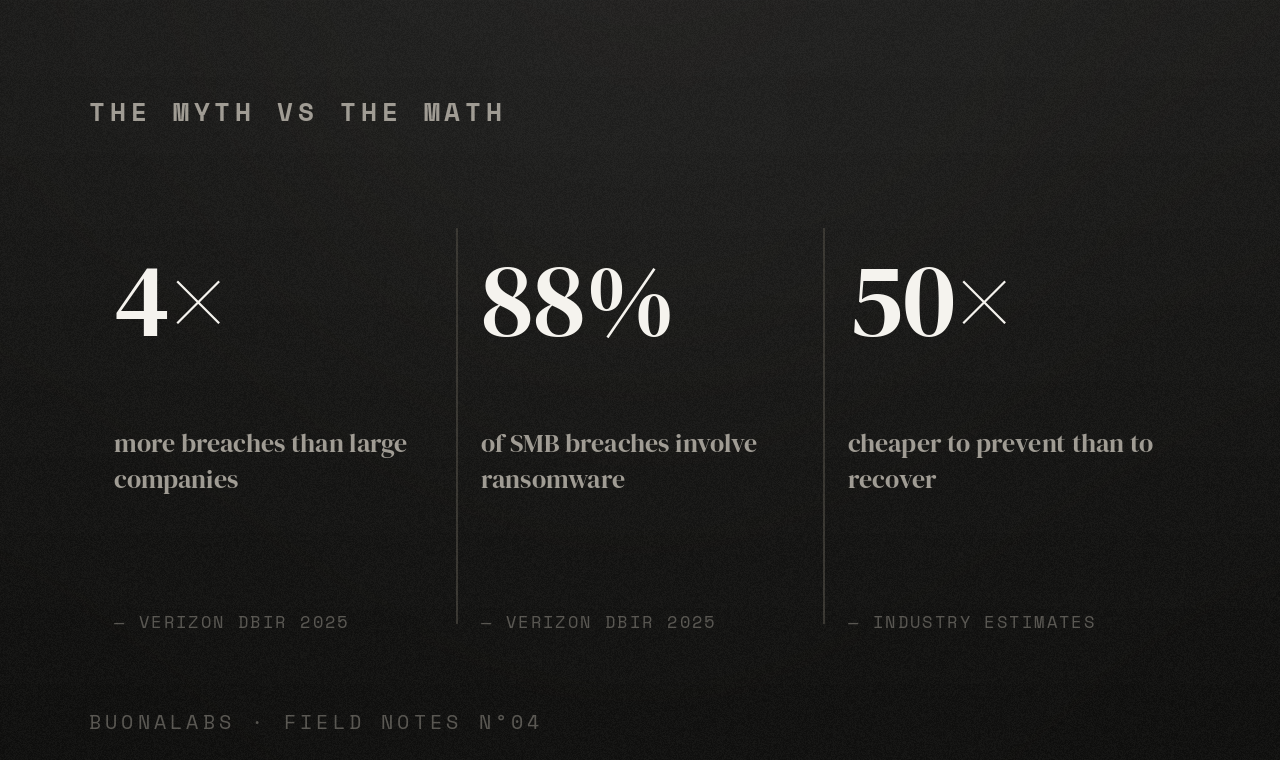
According to Verizon's 2025 Data Breach Investigations Report, small businesses suffered roughly four times as many confirmed breaches as large organizations. Companies with under 100 employees are about 2.5x more likely to be targeted than those with 500 or more.
By widely cited estimates, 43% of all cyberattacks are aimed at small businesses — and a majority of SMBs report being hit at least once in the past year.
The kind of attack matters too.
88% of SMB breaches in 2025 involved ransomware, compared with just 39% for large organizations.
Read that again: when a small business gets breached, it's overwhelmingly the kind of attack designed to lock up your operation and extort you — not a quiet data-skim, but a gun to the head of your ability to function.
This isn't bad luck or being caught in the crossfire.
Ransomware has become a targeted, professionalized industry, and small businesses are the intended customers of that industry's attention.
Why the economics flipped
To understand why, follow the money from the attacker's side.
A few years ago, attacking a small company rarely made sense.
A skilled human had to research the target, craft a convincing lure, find a way in, and run the operation — hours of effort for a payout that might be small.
The math favored going after big targets where the prize justified the labor.
Being small genuinely was a kind of camouflage.
Two things destroyed that camouflage.
Ransomware-as-a-Service (RaaS).
Attacking is now a subscription product.
Criminal groups rent out ready-made intrusion kits, infrastructure, and even "customer support" to lower-skilled affiliates, taking a cut of the proceeds.
This model has been growing on the order of 50% year over year.
It means the person hitting your business no longer needs to be an expert — they just need to rent the tools.
AI.
Generative AI collapsed the cost of the most effective part of the attack: the human deception.
AI-written phishing is dramatically more convincing than the typo-ridden scams of old — by some measures 4.5x more effective, with AI-generated lures achieving open rates of 54–78% versus around 12% for traditional ones.
AI-powered attacks reportedly surged around 340% in 2025.
When a machine can research your company, write a flawless, personalized lure in your language, and fire it at thousands of small targets at once, the cost per attack drops toward zero.
And here's the consequence that should change how you think: when attacks become cheap and automated, no target is too small to be worth it.
The attacker isn't choosing you for your size.
They're spraying a net across everyone who's easy — and then the automated systems sort the easy from the hard.
You don't have to be a tempting prize anymore.
You only have to be reachable and unprotected.
Why you, specifically, are easy
If the economics explain why now, your circumstances explain why you.
None of this is an insult — it's just the reality of running a lean business.
You probably don't have a dedicated security team; the "IT person" might be a founder, an office manager, or a part-time contractor.
Budgets are tight, and every euro spent on security is one not spent on growth, marketing, or hiring — a genuinely hard tradeoff that's easy to keep deferring. Systems go unpatched because nobody's job is to patch them. Software ages.
The single most common factor behind ransomware victims in 2026 is straightforward lack of expertise, closely followed by security gaps the organization didn't even know it had.
Then there's the human layer, which is where most attacks actually land.
Social-engineering attacks are roughly 350% more common against SMB employees, and the overwhelming majority of breaches involve simple human error — a clicked link, a reused password, a wire sent on a convincing request.
A small team moving fast, trusting each other, wearing ten hats each, is a softer target than a corporation with mandatory training and locked-down systems. Attackers know this perfectly well.
You're also a doorway
There's a second reason you're attractive that has nothing to do with your own bank balance: you're a way in to someone bigger.
If you supply, service, or integrate with larger companies, your access and your trusted relationship are the prize.
Compromising a small vendor to reach a large client is one of the most reliable plays in the modern attacker's book.
Your size makes you a weak link in a chain that's worth far more than you are — which means your security is increasingly your clients' problem too, and they're starting to ask about it.
What it actually costs
The "ransom" is the part everyone fixates on, and it's often the smallest line item.
For SMBs, the realistic cost of an incident typically runs from around $120,000 to $1.24 million depending on severity (Verizon), with IBM's figure for organizations under 500 employees landing around $3.31 million.
Sophos found the average ransomware recovery cost — excluding the ransom itself — for small firms of 100–250 people was over $638,000.
The reason the totals balloon is downtime: by some estimates, the cost of being unable to operate runs roughly 50x the ransom itself.
Add data loss, reputational damage, lost customers, and legal exposure, and a single breach can exceed the firm's annual profit several times over.
You'll often see the claim that "60% of small businesses close within six months of a cyberattack."
Be skeptical of that exact number — it traces back to a source from over a decade ago and gets recycled endlessly without scrutiny, and we'd rather give you the honest picture than a scary one.
The more defensible recent data is sobering enough: Verizon's 2025 report indicates roughly 19% of breached SMBs face bankruptcy, and surveys find around 40% of SMBs say an attack costing $100,000 or less would end their business, with three-quarters saying they couldn't continue operating if hit with ransomware.
Whether the true closure rate is 19% or higher, the signal is unambiguous: a meaningful share of small businesses simply do not survive a serious incident.
The trap that follows the first hit
It gets worse if you give in.
Paying a ransom marks you as a paying customer: around 69% of businesses that paid were attacked again, and roughly a third of victims are hit again within the same year.
There is no "pay once and it's over." Capitulation is an advertisement.
The genuinely good news
Here's the part that should change your week, not ruin it.
Because the overwhelming majority of attacks on small businesses exploit basic gaps — unpatched software, no multi-factor authentication, a clicked phishing link, no backups — the basics block most of them.
You are not being asked to outspend a nation-state.
You're being asked to stop being the easy one.
And the math here finally works in your favor: prevention costs on the order of 50 to 60 times less than recovery — think a few thousand a year versus hundreds of thousands per incident.
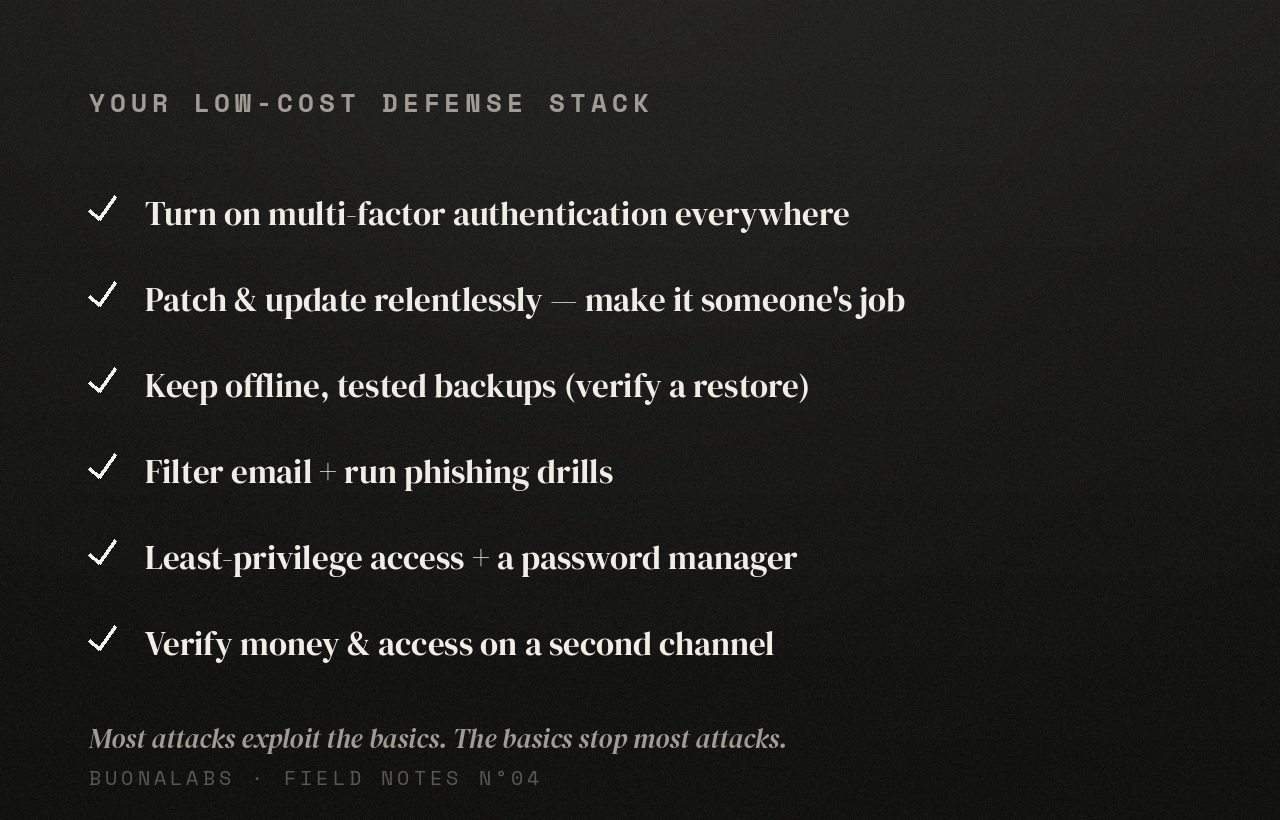
A right-sized defense for a small business looks like this, and most of it is cheap or free:
- Turn on multi-factor authentication everywhere — email, banking, admin accounts, key tools. This single step blocks a large share of account-takeover attacks.
- Patch and update relentlessly. Most intrusions ride in through known holes that a vendor already fixed. Make updating someone's actual job.
- Keep offline, tested backups. If you can restore your data, ransomware loses most of its power. Untested backups are not backups — verify a restore.
- Filter email and train for phishing. Since most attacks land via people, this is the highest-leverage spend there is. Run drills.
- Use least-privilege access and a password manager. People should only reach what they need; passwords should be long, unique, and not reused.
- Verify money and access on a second channel. As we covered in the deepfake piece, no funds move and no credentials change on a single message, call, or video alone.
- Write a one-page incident plan and consider cyber insurance — but read the conditions, since carriers increasingly require these controls to pay out.
None of that requires an enterprise budget.
It requires deciding that security is a line item, not an afterthought.
How we think about it at BuonaLabs
Most security advice is written for corporations and lands on small businesses as noise — overwhelming, expensive, and easy to ignore.
That's how companies end up with nothing.
We build security in, sized for how you actually operate: the controls that block the attacks small businesses actually face, baked into your tools and workflows so doing the safe thing is the easy thing.
Not a 200-page policy nobody reads. A defense that fits.
The old assumption — we're too small to matter — was the attacker's favorite sentence.
It kept you comfortable while the economics quietly turned against you.
In 2026, being small doesn't hide you; it markets you.
The businesses that come through the next few years won't be the ones with the biggest security budgets.
They'll be the ones who simply refused to be the easy target.
You were never too small to be attacked.
You were just small enough to be unprepared.
That part, you can fix.