The Only Witness Was the Phone

Europe's new ID wallet will make forged documents almost worthless.
That is exactly why the next big wave of fraud won't need one.
The call came on a Tuesday, a little before ten.
Helmut Brandt was halfway through the crossword when his mobile lit up with a Kiel number he didn't know.
"Kriminalhauptkommissar Wendt, Landeskriminalamt," said the voice.
Measured, a little tired, the way real officials sound at the end of a long shift. "Herr Brandt, please don't be alarmed. Your name turned up in material we seized last night."
Over the next eleven minutes, Wendt laid it out.
A gang had someone inside Helmut's bank.
They were preparing to drain accounts belonging to older customers.
The police needed his help to catch the insider, which meant two things.
He must not mention the call to anyone at his branch.
And he must stay on the line, because if he hung up, Wendt could no longer guarantee his money was safe.
Then came the small request.
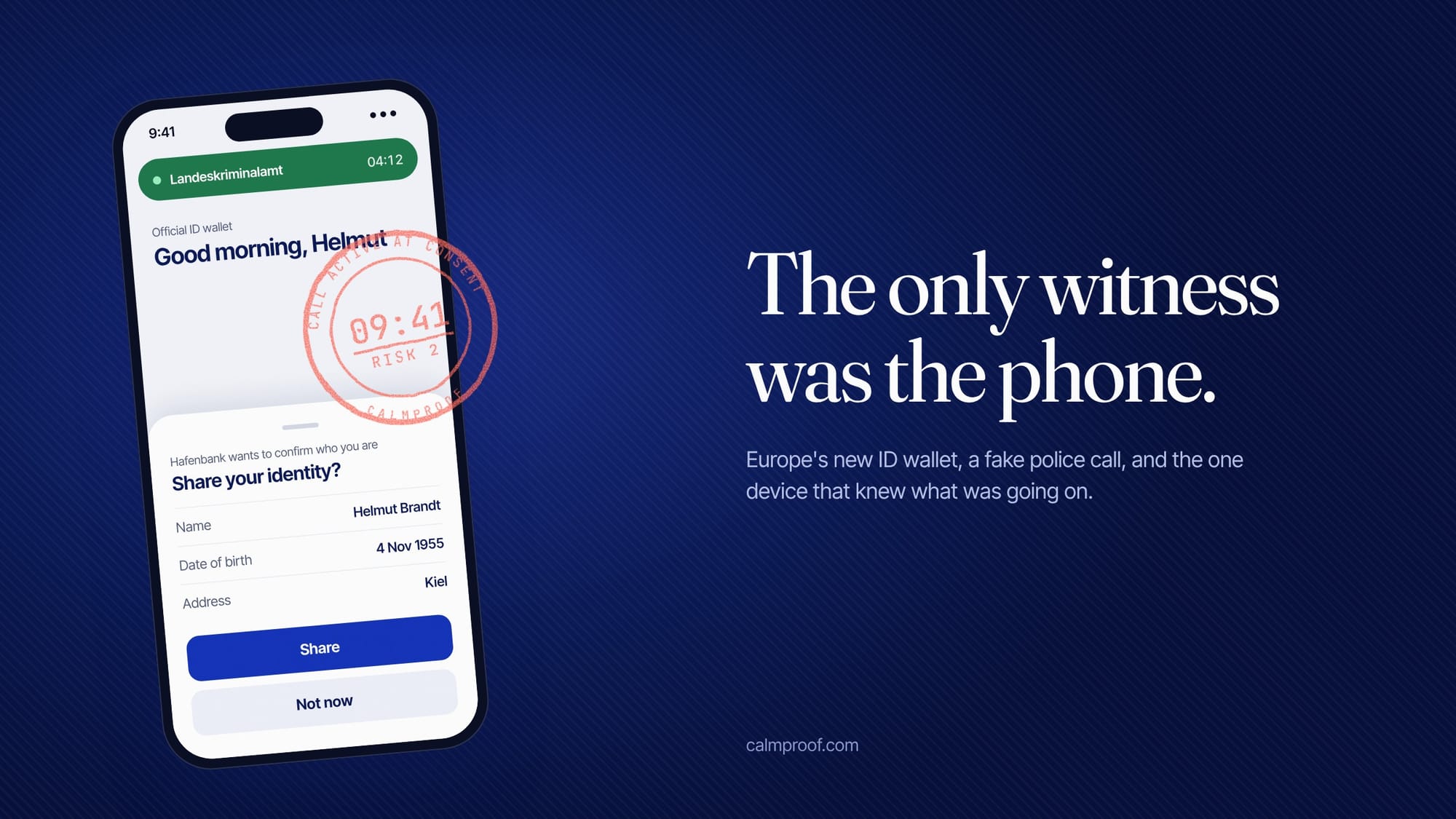
"Hafenbank will send a confirmation to your ID wallet.
When it arrives, approve it.
That lets us move your savings into a protected account while we work."
The request arrived.
It really came from Hafenbank.
The wallet was the official one from the government.
The ID inside it was Helmut's own.
Helmut is 71.
He spent forty years as an engineer at the Kiel shipyards, checking load calculations for cranes that lift whole hull sections.
He is not a careless man.
He did what careful people do when the police ask for help.
He tapped Share.
By the afternoon, a new account in his name had been opened with a government-grade digital identity.
His savings had passed through it and were gone.
Helmut is invented.
Every detail of his morning is borrowed from real cases.
It isn't hacking. It's theatre.
When people hear stories like Helmut's, the first reaction is usually some version of "I would never fall for that."
Fraud investigators hear that sentence a lot, often from victims, about the week before it happened to them.
These scams don't work because the target is foolish.
They work because they are staged.
The script gives the victim an authority to obey, a secret to keep ("don't trust your branch"), and a clock that is always running out.
Germans even have a name for the genre: the Schockanruf, the shock call. Germany's Federal Criminal Police Office reported in 2025 that losses from calls by fake police officers and fake relatives had risen again.
The damage is far from marginal.
The European Banking Authority and the ECB found in a joint report in December 2025 that 74% of the value lost to credit-transfer fraud in the EU comes from customers being manipulated into paying, not from stolen logins.
A survey by the Global Anti-Scam Alliance put Germany's scam losses for 2025 at an estimated €10.6 billion, and found that more than half of German adults had been targeted at least once in a year.
One stage direction appears in almost every version of the play, and it is the important one for what follows: don't hang up.
The open line is how the scammer keeps doubt out.
As long as the voice is in your ear, there is no pause to call your daughter or ring the branch, and no quiet in which the small alarm in your head can get louder.
That open line is the scammer's greatest strength.
It is also the one thing that is almost always there.
Europe is building a bigger stage
In a few weeks, the European Digital Identity Wallet stops being a policy paper. Every EU country has to offer one: an official app that carries your ID card, and later your driving licence and other documents, and lets you prove who you are with a tap.
It is a good idea, and we mean that.
It is more private than emailing a photo of your passport and much harder to fake than a video-ident call.
Within two years it will be completely normal for a bank to say "please confirm in your wallet."
The schedule matters, because the parts don't arrive together.
Wallets come first.
The obligation for banks to accept them follows a year later.
The rule that makes banks pay for impersonation fraud comes after that.
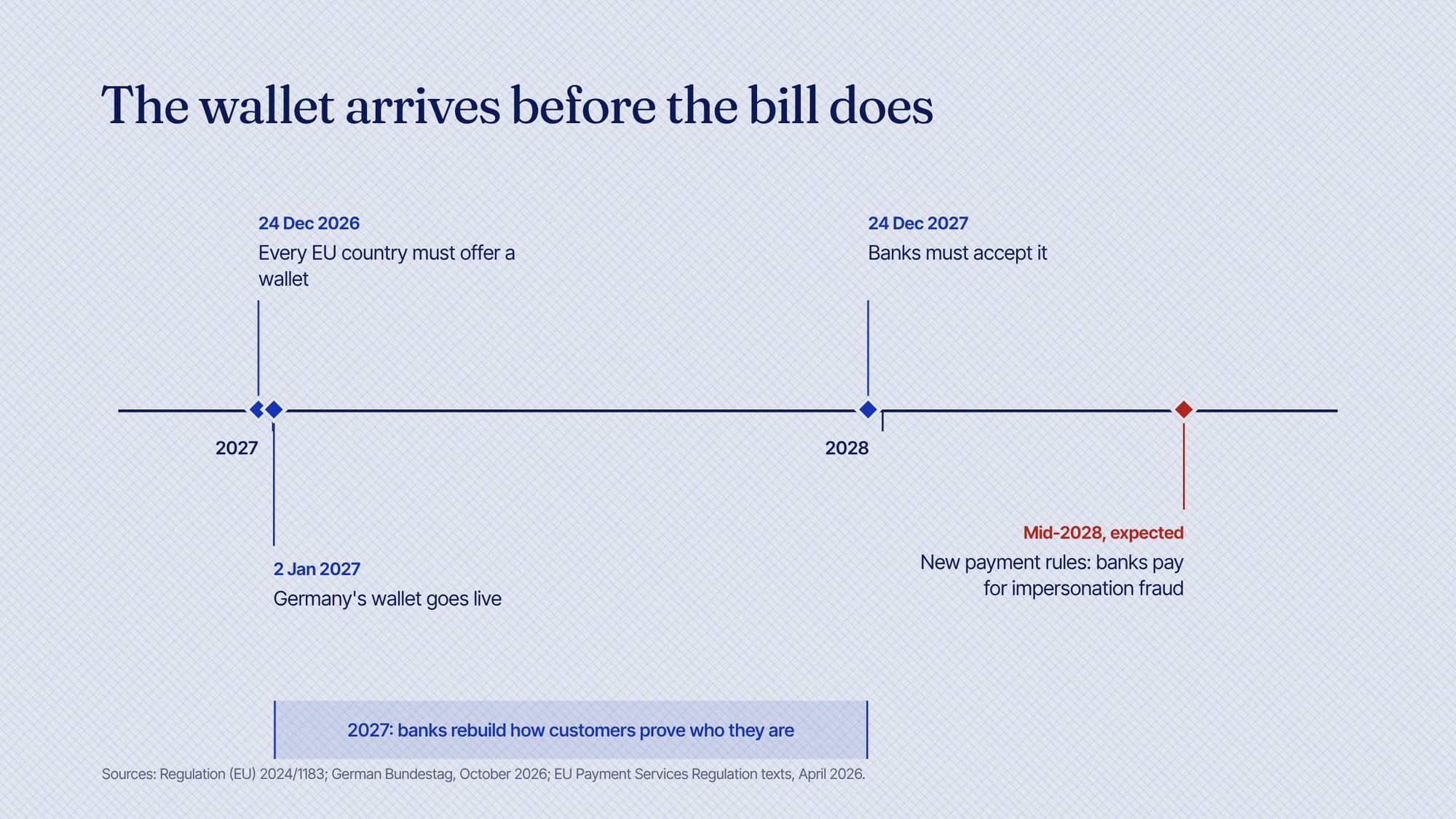
The wallets arrive in 2026. The rules on who pays for fraud follow in 2028.
There's a paradox in this.
The better the wallet gets at stopping forgery, the less point there is in forging anything.
A criminal who can't fake Helmut's ID has an easier option: get Helmut to share the real one.
The wallet secures the document very well.
Nothing in it secures the person holding the phone, or tells anyone what is happening around him while he does it.
The witness nobody asks
Go back to 9:52 on Helmut's Tuesday.
One object in his kitchen knew precisely what was going on.
His phone knew a call had been running for eleven minutes, from a number that wasn't in his contacts.
If Wendt had talked him into installing a "security app" that let someone steer the screen, the phone would have known that too.
The same goes for a shared screen, or a code that arrived from a computer somewhere else.
Operating systems track these states all day long for ordinary reasons, like pausing your music when someone rings.
But when Helmut tapped Share, all of that stayed behind.
Hafenbank received a flawless identity and not one word about the circumstances. Its fraud system checked what it always checks: right person, right device, genuine wallet, fresh request.
Every light was green.
It's a strange position to be in.
The phone was the only witness in the room, and the way identity wallets work today, nobody ever asks it a question.
A postmark for your identity
Think about what a postmark does.
It tells you when a letter was sent and how it travelled.
It never opens the envelope.
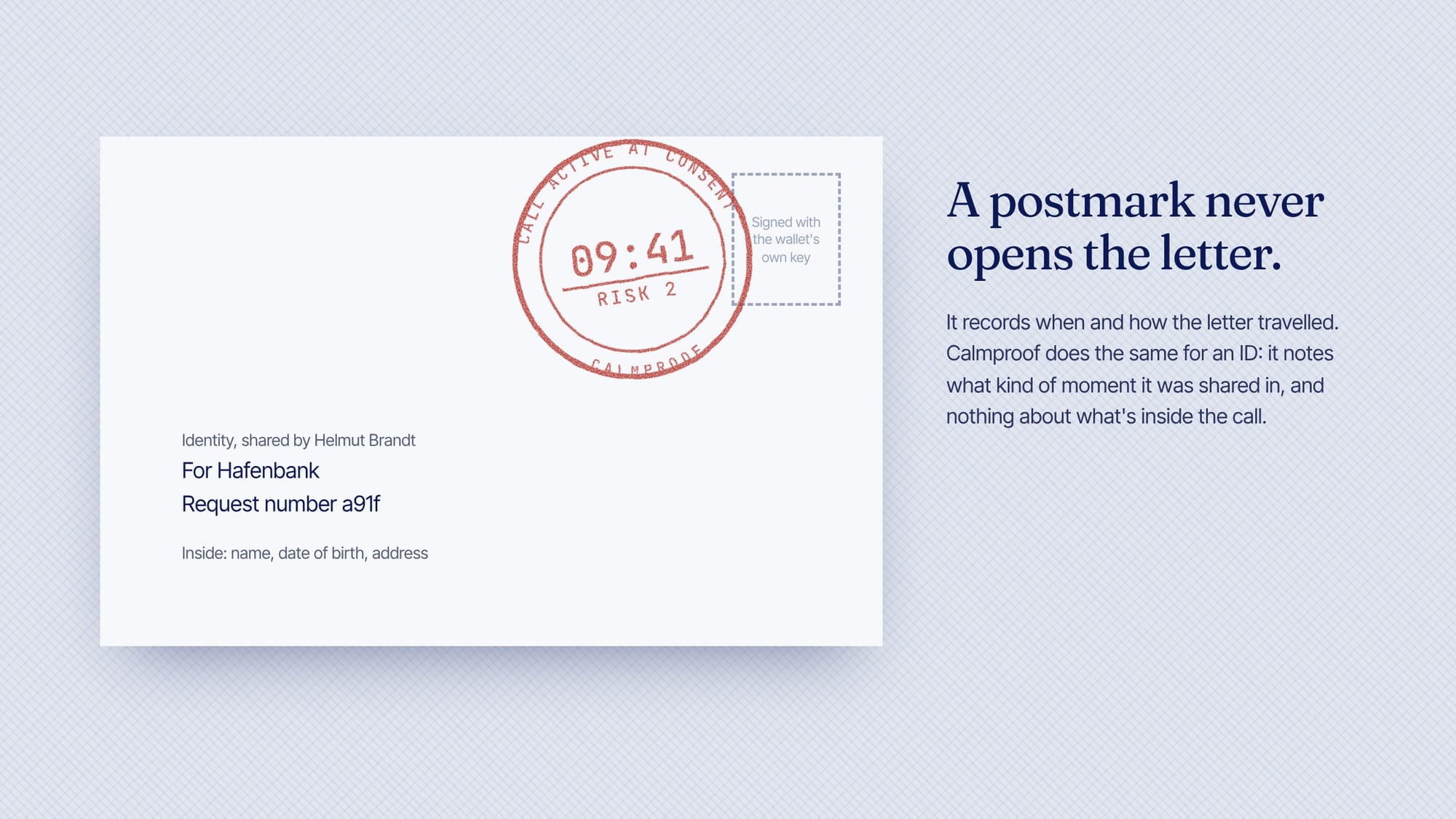
Calmproof adds a postmark to the identity, never a copy of the call.
Calmproof gives the ID wallet a postmark.
When the wallet hands an identity to a bank, it adds a short note about the circumstances, written on the phone at the second the person agrees:
- what kind of moment it was: a phone call running, the screen being shared, someone controlling the phone remotely, or a QR code that came from a device that isn't nearby
- a risk level from 0 to 3
- which request the note belongs to, and the time
- what this particular phone is able to notice at all
The note is signed with the same key as the identity and tied to that one request.
It can't be peeled off, copied onto another request or quietly dropped along the way.
If someone tampers with it, the bank's check fails.
Before anything leaves the phone, there's a second job: talking to the person.
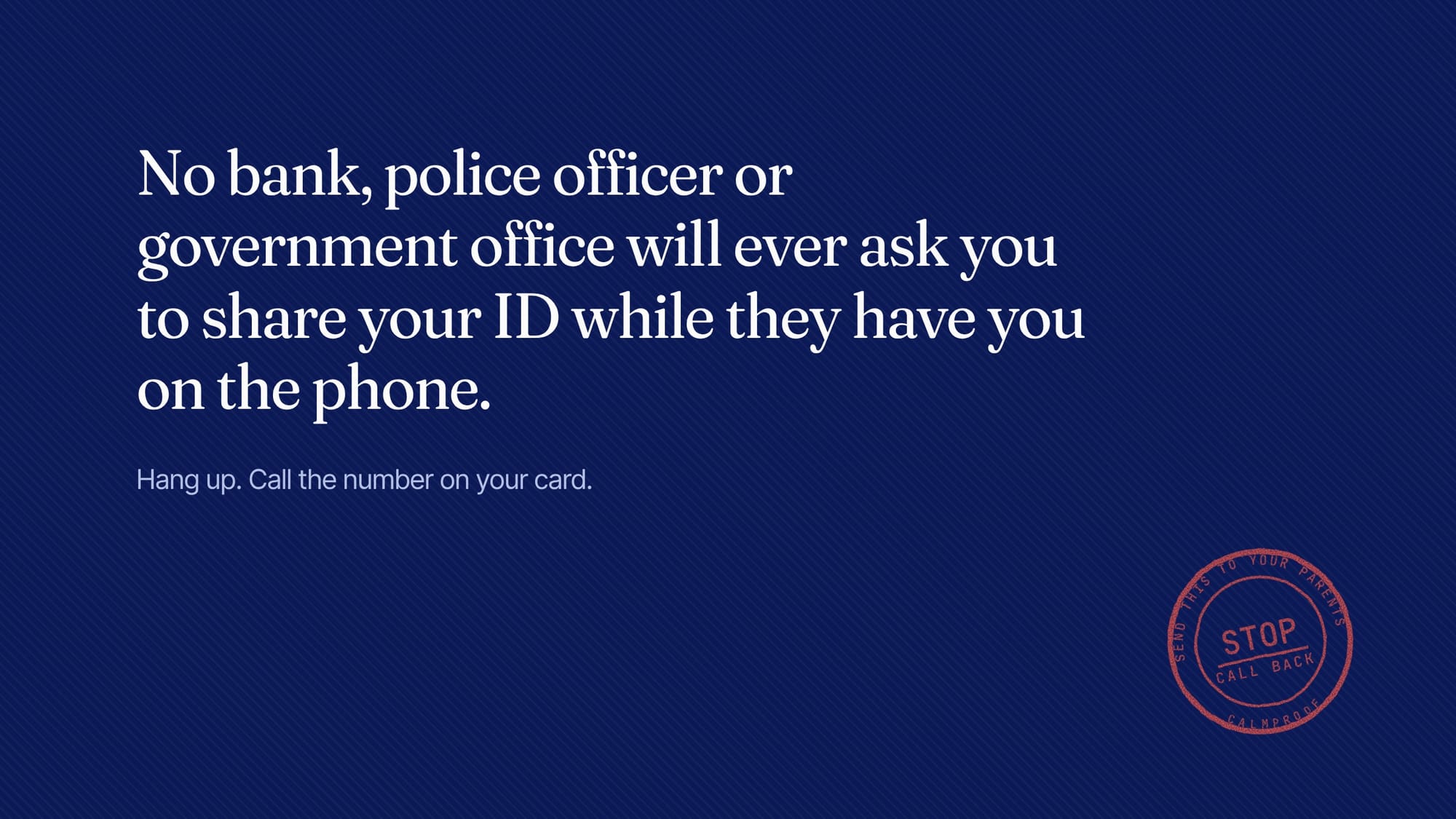
If a call is running, the wallet says so, in plain language: Your bank will never ask for this during a phone call. You can hang up now and call the number on your card.
Depending on the risk, it can ask for a second confirmation, wait a few seconds, or refuse.
That pause matters more than it sounds.
A shock call depends on momentum, and a few seconds of quiet is often enough for doubt to get in.
The bank then does what it already knows how to do: apply its own rules.
Approve.
Call the customer back on the number it has on file.
Hold the payment.
Send it to a person.
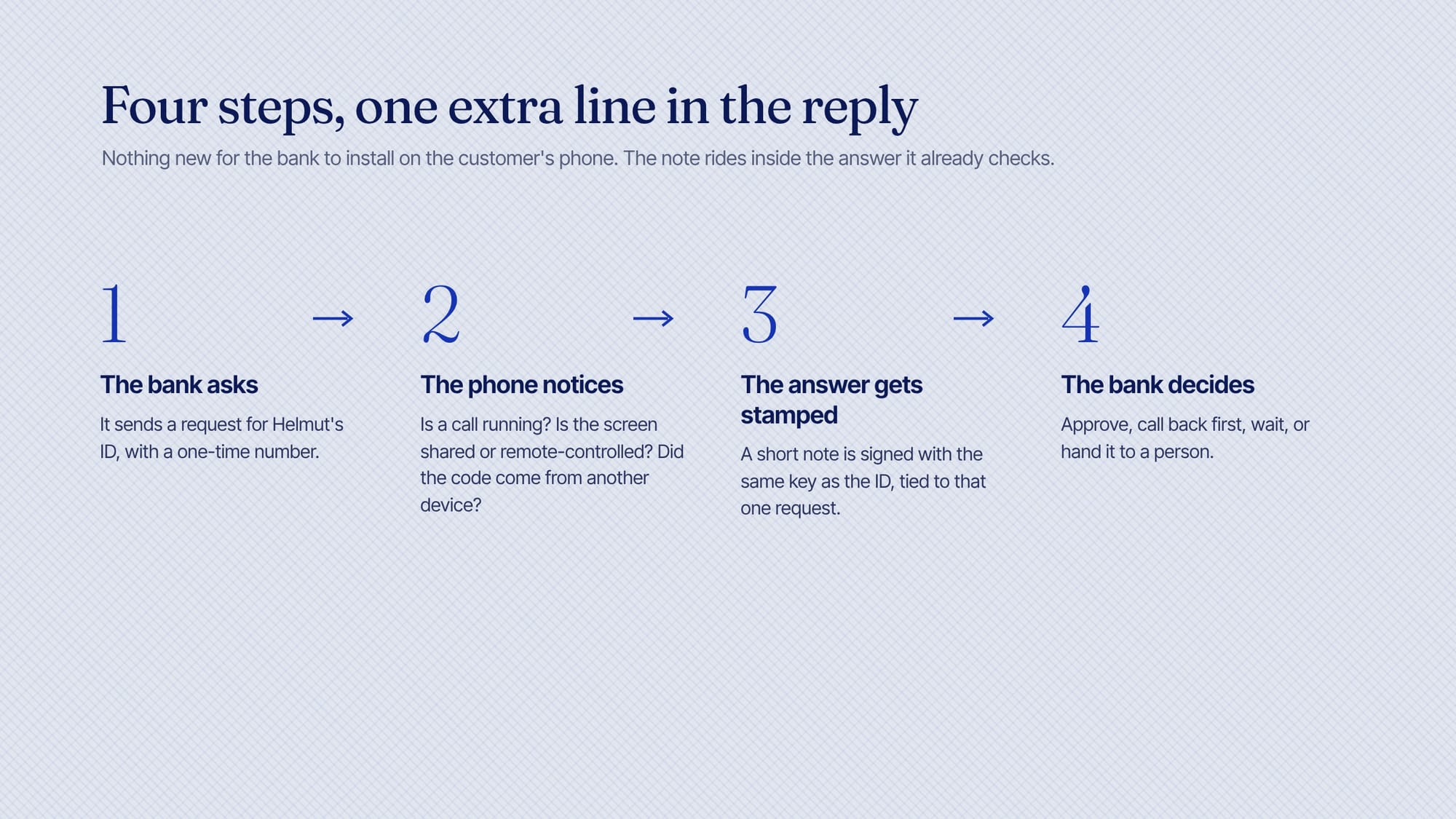
The note rides inside the response the bank already checks.
For the technically minded, none of this needs new infrastructure.
The note travels inside the response the bank already verifies, using the open standards the European wallet is built on (OpenID for Verifiable Presentations, SD-JWT credentials and ISO mdoc).
There's no bank software to install on the customer's phone.
Tuesday, second take
Same kitchen, same crossword, same tired voice from the "LKA".
The request from Hafenbank arrives while Wendt is still talking.
This time the wallet doesn't just show the share button.
Above it, a short message tells Helmut that his bank never asks for this during a call, and that he can hang up and ring the number on his card.
Maybe that's enough, and he hangs up. Plenty of people would.
Maybe it isn't.
Wendt is good, and he has a line ready: "Yes, the system shows that warning, the insider set it up to scare you off." Helmut shares anyway.
But now Hafenbank receives his identity with the postmark attached: phone call running, risk level 2.
The new account doesn't open.
An hour later someone from the bank's fraud team calls Helmut on the landline number they've had for twenty years, and the whole story falls apart in about two minutes.
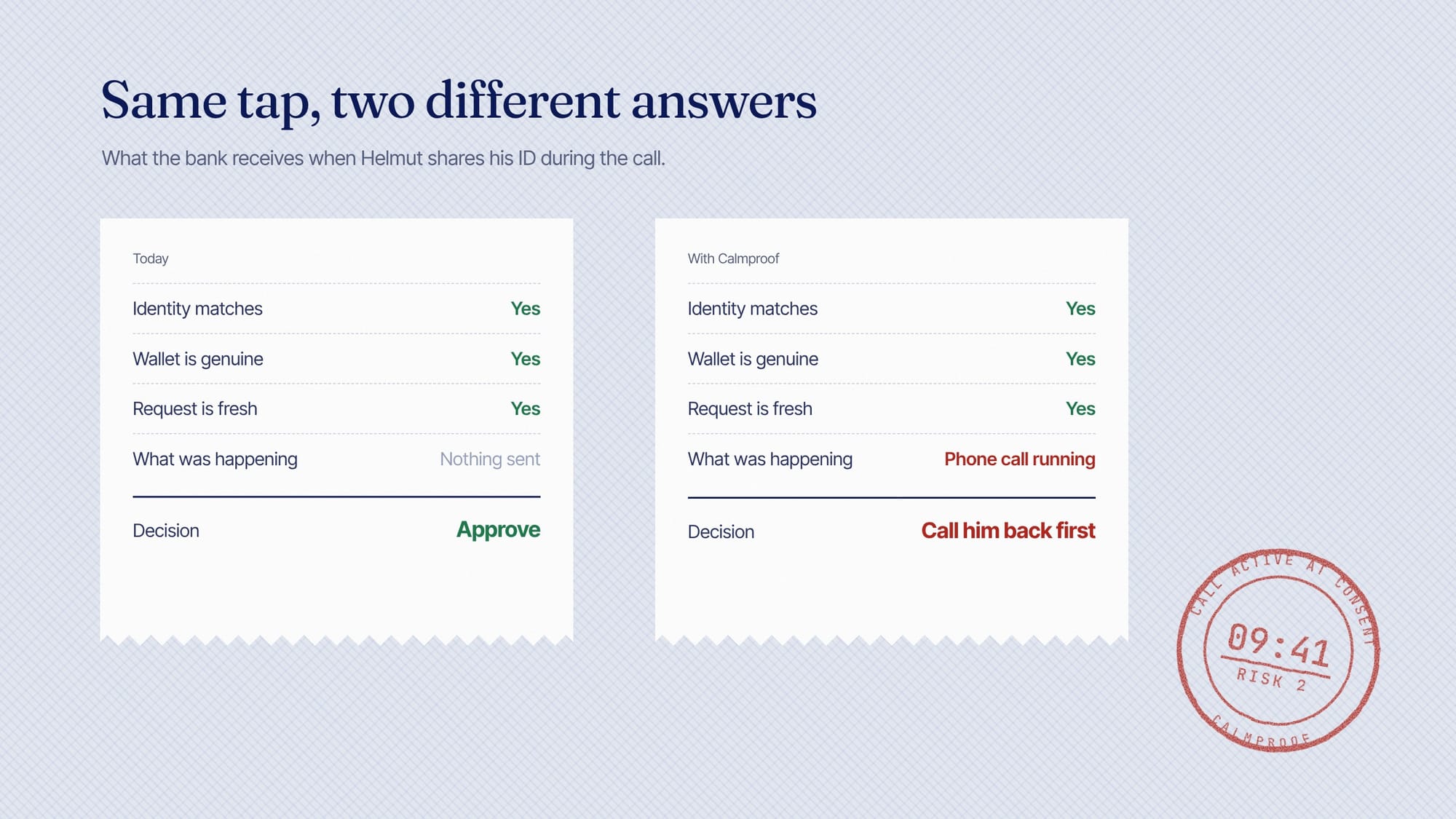
Same tap, same genuine ID. Only one bank knows a call was running.
Wendt never finds out why. He just moves to the next name on his list.
Four scripts, four fingerprints
The shock call is the best known script, but not the only one.
What they have in common is that each one needs a prop, and every prop leaves a trace on the device.
The fake police officer needs the call to stay open.
The friendly "technician" needs remote control of the phone, which is why he insists on that support app.
The refund scam needs you to scan a QR code he sends from his own computer, so your identity lands in his session, maybe hundreds of kilometres away.
And the walkthrough scam needs to see your screen while you tap.
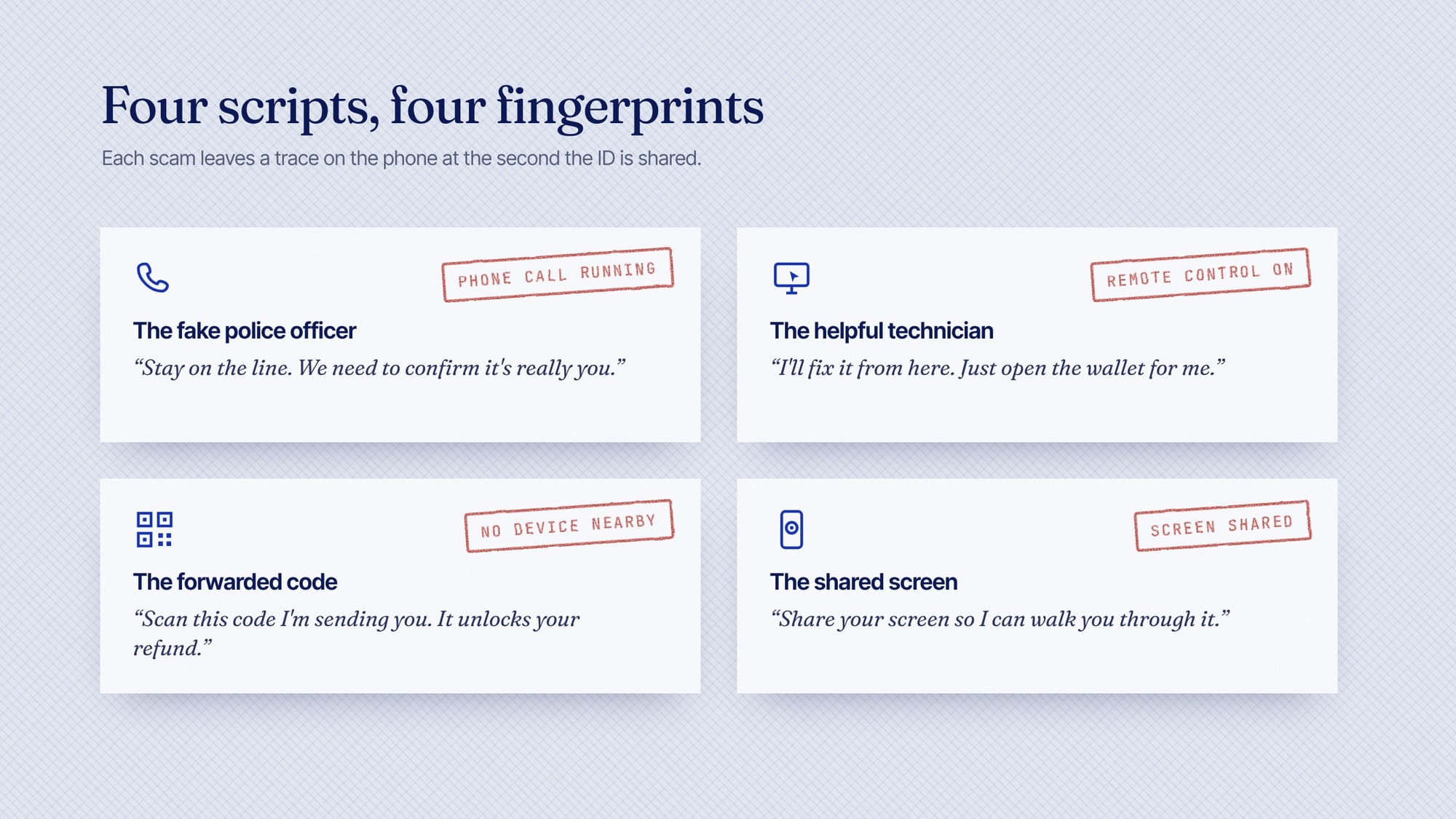
Every scam script needs a prop, and every prop leaves a trace.
To a bank, all four victims look like legitimate customers doing something perfectly ordinary.
To the phone, each of them looks like exactly what it is.
"So my phone reports on me to the bank?"
It's the right question to ask, and if the answer were yes, we wouldn't build this.
The phone does all the judging itself.
What leaves the device is the postmark and nothing else, and only attached to an identity the person decided to share.
The bank learns that a call was running.
It never learns whose number it was, who was speaking, what was said, how long it lasted or where Helmut was sitting.
It gets no list of his apps and no access to his contacts.
The person can see what the note will say and can still cancel the whole thing.
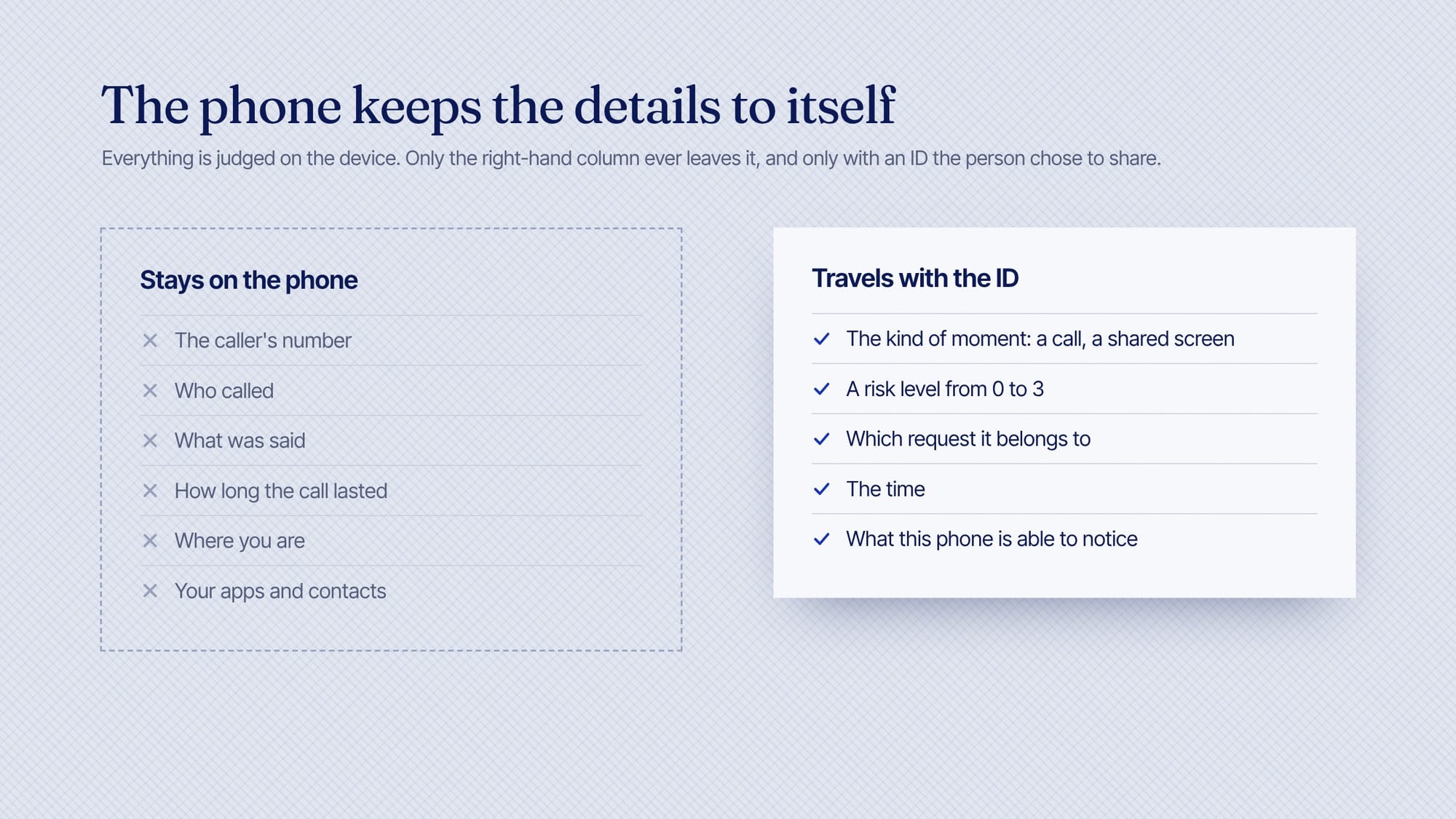
Judged on the phone; only the right-hand column ever leaves it.
Two details took us the longest to get right.
The first is accessibility.
Many older and disabled people use screen readers and similar tools, which can look a bit like remote control from the system's point of view.
Those tools never count against anyone on their own.
Nobody should be treated as a fraud risk because they need help reading a screen.
The second is honesty about blind spots.
Not every phone can see every signal.
So each note also says what that phone is able to detect.
A quiet note from a phone that simply can't see calls is never mistaken for a quiet moment.
Who pays when it goes wrong
For years, when a customer was talked into authorising a payment, the loss usually stayed with the customer.
The bank's position was simple: you confirmed it yourself.
That position is ending.
Under the EU's new Payment Services Regulation, when a fraudster pretends to be the bank, the bank is expected to carry the loss.
Once that applies, every fraud team will face a harder question from customers, ombudsmen and supervisors: what did you actually do to spot it?
A postmark gives them something concrete to point to.
It's one more input for the fraud engine they already run, under their own rules. It's evidence, signed at the source, of the conditions at the moment the identity was shared.
And it costs the customer nothing: no extra app, no extra data about them.
Wallet providers have their own reason to care.
When banks start choosing which wallets to trust with high-value transactions, "we protect people during the call" is a strong thing to be able to say.
The timing works in everyone's favour.
Banks are rebuilding their customer onboarding for the wallet during 2027 regardless.
Adding the postmark while that code is open is far cheaper than going back for it later.
What it can't do
We'd rather say this ourselves than have a fraud analyst say it in the comments.
Calmproof doesn't know what was said on a call, and it doesn't try to guess who is lying.
It describes the circumstances.
People decide what they mean.
It won't end fraud.
Criminals adapt, and some will try to work around it.
The aim is narrower: make the most common scripts visible and expensive to run, at the exact point where today they are invisible.
And its numbers have to be earned.
How often it catches each scenario, how often it raises a false alarm, and how much delay it adds are measured in every pilot, against the partner's own test cases.
Where this stands
Calmproof is built by BuonaLabs in Lübeck.
We filed a German patent application on 21 October 2026, and a draft specification for OpenID4VP is available on request.
If you want to see it rather than read about it, the sandbox at sandbox.calmproof.com is open.
Create a test account, send a request to the web wallet, then switch on a fake call or a shared screen and watch the postmark change.
The technical overview and data-protection notes are at calmproof.com/docs.
For 2027 we're looking for a small number of banks, payment providers and wallet makers, starting in Germany and Italy, for pilots of eight to twelve weeks.
Fully remote, with measured results at the end.
And if you work in fraud or identity and think this breaks somewhere, we genuinely want to hear where.
That's the most useful comment anyone can leave under this post.
One last thing, for everyone else.
Most people reading this won't build a wallet or run a fraud team, but almost all of us know someone like Helmut.
Send them the rule below.
It costs nothing, and on the right Tuesday it's worth everything they've saved.