

Most Smart-Contract Disasters Aren't Hacks.They're Unaudited Mistakes.

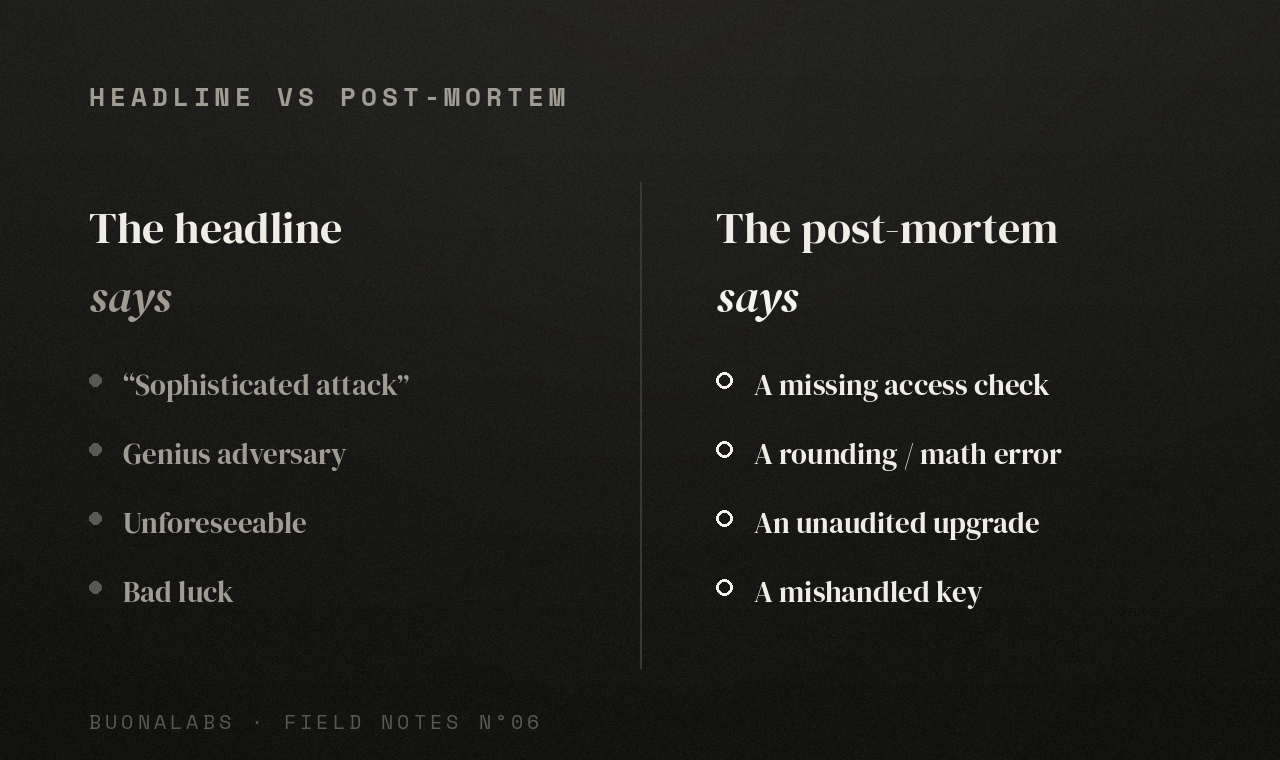
The headlines say "sophisticated attack."
The post-mortems say "a missing check."
In Web3, code is law — and the law ships your bug to the entire world, immutably, with the money already inside.
A protocol loses $200 million overnight.
The headline writes itself: hacked by sophisticated attackers.
It conjures a shadowy genius bent over a keyboard, defeating clever defenses with some never-before-seen exploit.
Then the audit report comes out, and the truth is almost always more embarrassing than the myth.
A function that should have checked who was calling it didn't.
A piece of arithmetic rounded the wrong way.
An upgrade shipped without anyone reviewing it.
The "sophisticated attacker" simply noticed a door that had been left unlocked — often a door that a single afternoon of proper review would have closed.
This is the uncomfortable open secret of blockchain security: most disasters aren't hacks in any heroic sense. They're mistakes. Preventable ones.
The scale of the problem
2025 was a brutal year for the space.
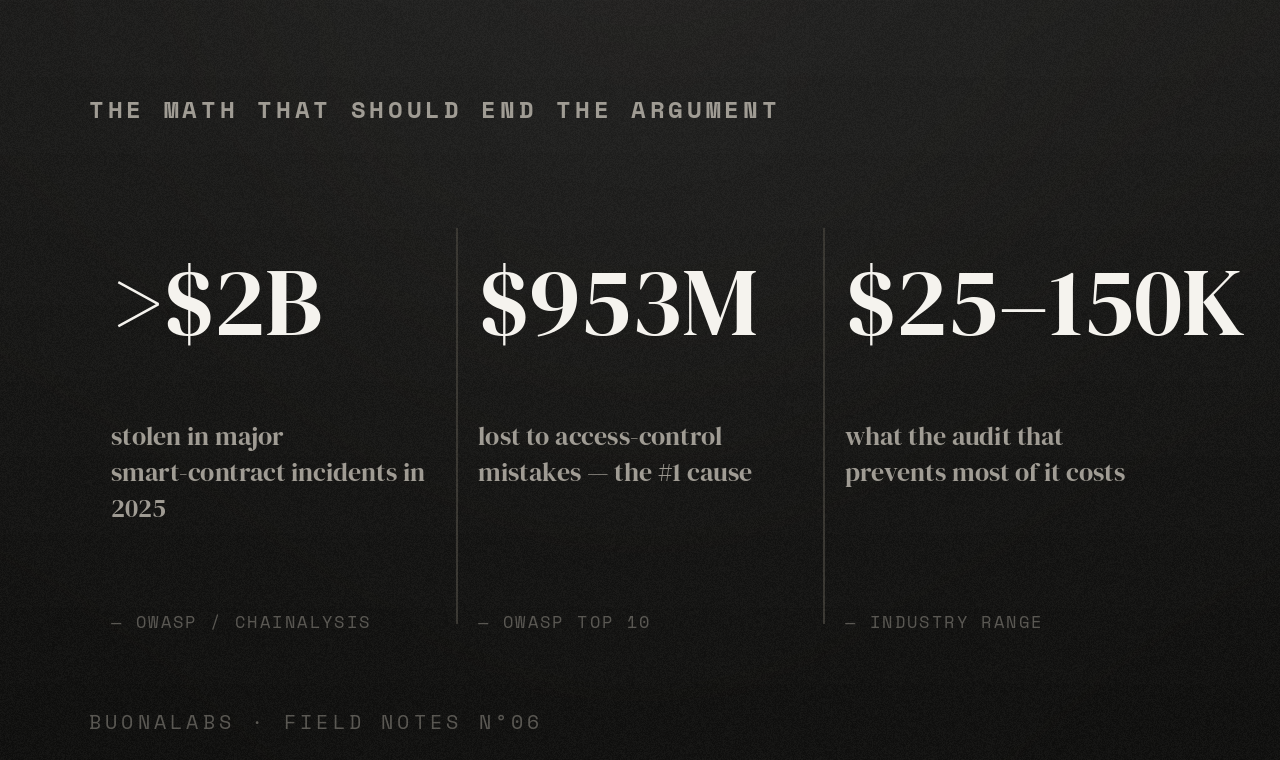
Major incidents drained well over $2 billion, and by Chainalysis's tally, custody-related breaches alone exceeded $3.4 billion.
When the OWASP Smart Contract Top 10 team deduplicated and analyzed the year's contract-level incidents specifically, they counted 122 events totaling roughly $905 million in smart-contract-involved losses.
These aren't fringe projects run by amateurs.
They include funded protocols with real users and real money.
And when you read the breakdowns, a pattern emerges that has almost nothing to do with criminal brilliance and almost everything to do with engineering discipline that wasn't there.
The myth of the genius hacker
Look at what actually goes wrong, according to the 2026 OWASP Top 10 — a list built directly from 2025's incident data.
The single leading cause of loss is access control failures: code that doesn't properly verify who is allowed to do a sensitive thing.
By one accounting, access-control flaws were responsible for around $953 million in damages.
That's not an exotic exploit.
It's the digital equivalent of building a vault and forgetting to lock it.
Right behind it sit business-logic flaws — the contract does exactly what it was written to do, but what it was written to do was wrong: a lending rule that can be gamed, a token-minting path that shouldn't exist.
Then come reentrancy (an old enemy that keeps reappearing in new disguises), oracle manipulation (feeding the contract a false price), and upgrade and proxy risks (the mechanism meant to let you fix bugs becomes the bug).
Reentrancy is worth dwelling on, because it's the perfect illustration.
It's the same class of bug that drained "The DAO" of around $60 million back in 2016 — an incident so severe it split Ethereum into two chains.
Nearly a decade later, with the flaw documented in every security guide on earth, reentrancy still shows up in fresh post-mortems.
The knowledge to prevent it has existed for years.
The discipline to apply it, evidently, is rarer than the knowledge.
The concrete cases tell the same story.
In 2025, the Cetus protocol lost around $223 million to a liquidity-math overflow — an arithmetic mistake.
Balancer's v2 took a roughly $120 million hit from rounding errors combined with access-control slips.
These are not the work of unstoppable masterminds.
They're the work of code that shipped before it was ready, found by people who were simply paying attention.
Why crypto is uniquely unforgiving
Every kind of software has bugs.
What makes smart contracts different is that the usual safety nets don't exist.
In a normal web application, a bug is embarrassing but recoverable: you push a hotfix, restore from backup, refund the affected users, and move on.
A smart contract offers none of that mercy.
Once deployed, your code is public (anyone can read it, and adversaries do), immutable (you generally cannot just edit it), and holding real money from the first block.
"Code is law" sounds inspiring on a conference slide.
In practice it means your mistake is the law — enforced automatically, at machine speed, in front of an audience of thousands of bots that scan every new contract for exactly the kind of slip described above.
There is no undo.
There is no "we'll patch it Monday."
The window between "deployed" and "drained" can be minutes.
That is the entire reason the discipline around smart contracts has to be different in kind, not just in degree, from ordinary software.
It's not only the contract
Here's a nuance the hype often misses, and it matters.
Some of 2025's largest losses weren't smart-contract bugs at all.
The record-setting Bybit incident — roughly $1.4 billion — came through a compromise of the signing and operational setup, not a flaw in contract code.
Much of the real damage in Web3 now comes from the surrounding surface: hijacked multisig wallets, supply-chain attacks on developer tooling, drainer malware, and old-fashioned phishing of the people who hold the keys.
The lesson isn't "ignore the contract."
It's that securing a blockchain product means securing the whole system — the code, yes, but also the keys, the deployment pipeline, the upgrade authority, and the humans who operate all of it.
A perfectly audited contract with a carelessly managed admin key is still a disaster waiting to happen.
The economics that should end the argument
Now hold two numbers next to each other.
A comprehensive smart-contract audit typically costs somewhere between $25,000 and $150,000, depending on complexity.
The mistakes it's designed to catch routinely cost tens or hundreds of millions.
Cetus: $223M. Balancer: $120M.
Access-control flaws across the year: nearly a billion.
Framed that way, skipping or rushing the audit to "save money" or "ship faster" isn't a cost saving.
It's the single most expensive decision a protocol can make — a six-figure economy in pursuit of a nine-figure risk.
The audit is not bureaucracy slowing you down.
It is, by a wide margin, the cheapest insurance available in all of software.
What discipline actually looks like
The projects that survive aren't the ones with the most brilliant developers.
They're the ones with the most disciplined process.
Concretely, that means:
- Audit before you deploy — and for high value, audit more than once. Independent eyes catch what the authors can't see, precisely because they didn't write it.
- Lean on battle-tested libraries like OpenZeppelin instead of hand-rolling critical logic. Most catastrophic bugs live in custom code that reinvented something already solved and hardened.
- Use the tooling.
Static analyzers, fuzzers, and invariant testing catch whole classes of error cheaply and automatically, before a human ever reviews them. - Stage everything.
Testnets, gradual rollouts, and value caps on new code mean a mistake costs a little, not everything. - Put timelocks on upgrades and manage keys properly.
The power to change a live contract is the power to destroy it; treat it accordingly, with multisig done right and no single point of failure. - Run a bug bounty and monitor in real time.
Pay a researcher five figures to find the bug before an attacker finds it for free.
None of this is glamorous, and that's the point.
Security in Web3 is not a feature you add.
It's a discipline you practice — or a post-mortem you eventually write.
An audit is a floor, not a ceiling
One honest caveat, because we'd rather be useful than sell you false comfort: an audit is not a magic shield.
Some audited projects have still been exploited — because an audit is a snapshot of specific code at a specific moment, and security can be undone by a later upgrade, a new integration, a market condition the auditor didn't model, or a key that gets mishandled afterward.
A clean audit report is not a certificate of invincibility, and any firm that implies otherwise should worry you.
What an audit does is dramatically lower the odds and catch the obvious, costly mistakes that account for most losses.
So treat it as the floor of a serious security posture, not the ceiling: choose reputable auditors, re-audit when you change meaningful code, keep monitoring live, and keep a bug bounty running.
The goal isn't a piece of paper that says "safe." It's a practice that stays safe.
How we think about it at BuonaLabs
We treat smart-contract work as security-first by default, because the cost of treating it any other way is total and irreversible.
We build with audited patterns and hardened libraries, test against the failure modes that actually drained protocols last year, and design the operational layer — keys, upgrades, deployment — with the same seriousness as the code itself.
It's also why we built our own EVM Decompiler: when you can read what bytecode actually does on-chain rather than trusting what it claims to do, you catch the gap between intention and reality — which is exactly the gap where the money disappears.
The disasters that make headlines almost never required a genius to cause.
They required someone to skip a step — to ship the unaudited upgrade, to trust the unchecked function, to assume the rounding would be fine.
In a world where code is law and the money is already inside, "we'll fix it later" is a sentence that doesn't exist.
So do the unglamorous work first.
The alternative isn't a bug report.
It's a tombstone with a number on it.