
Every Return Is a Design Review

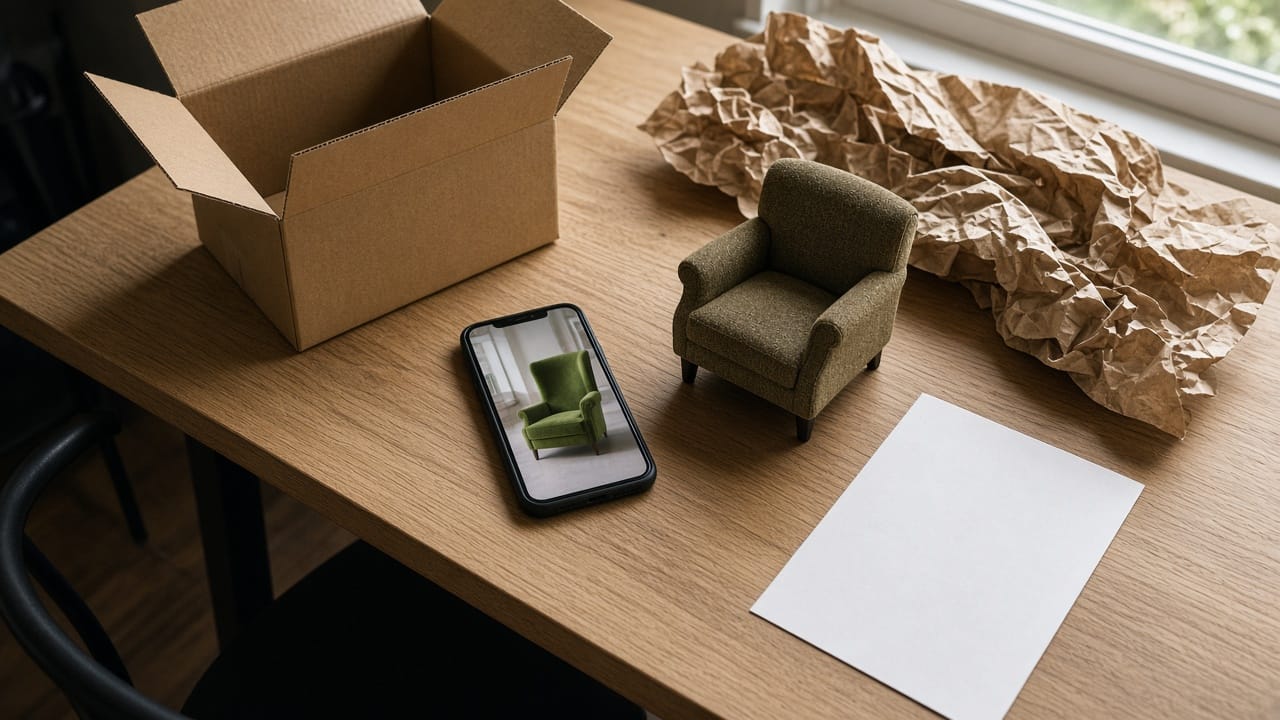
The most honest review of your product page doesn't happen on the page.
It happens three days later, on a kitchen table, when the box comes open.
A return isn't a logistics problem. It's a design review — conducted by the only critic who paid to attend.
The most expensive moment in e-commerce is not the click.
It's the half-second after the lid comes up — the one where someone holds the thing they thought they bought, and their face either settles or falls.
If the object matches the promise, you get a customer.
If it doesn't, you get a box going the other way, a write-off, and a person who will not come back to explain themselves.
Most brands file that moment under operations. Reverse logistics. Policy. A cost of doing business online.
It isn't.
It's a design review.
The product page made a promise. The object just testified.
And unlike a heatmap or a survey, this critic paid retail to attend.
The receipt you never wanted
Returns are one of the few things in digital commerce we measure honestly, because they hurt too much to ignore.
In October 2025 the National Retail Federation and Happy Returns put U.S. retail returns at $849.9 billion — 15.8% of sales.
Online is worse: they estimate 19.3% of online sales come back, nearly one order in five.
The same survey found 82% of consumers treat free returns as a major consideration when they buy.
The unit cost is the part finance actually feels.
Optoro puts it plainly: processing a $100 item costs about $30.
That is before you count the outbound shipment you already paid for, or the fact that a bulky return — a sofa, a bed — often cannot go back out as new.
On a lot of SKUs, one return does not cost you 20% of the margin.
It costs you the margin.
That is not a rounding error.
That is a second business, running in reverse, quietly eating the first one.
And yet the industry still talks about returns as if they were weather.
Inevitable. A feature of distance selling.
Something you manage with a more generous policy, or a stricter one, or a prepaid label that makes the disappointment feel slightly more polite.
The policy is not the cause.
The cause happened earlier, on the page.
What people are actually sending back
Ask why an item comes home and the answers cluster in a very small set of rooms.
DHL's 2025 shopper survey — 24,000 people, 24 countries — found that 54% of global shoppers have returned an item because it was the wrong size.
Optoro found bracketing (buy three sizes, send two back) is most common in apparel and accessories, at 56%.
A peer-reviewed fashion-returns study put "did not fit" at 62% and "not as described" at 30%.
Notice what is not first on that list: defects. Damage. A change of heart.
Those happen. They are not the engine.
The engine is representation.
The picture said one thing. The object said another.
The customer is not being fickle. They are being accurate.
This is the part brands keep missing because it is slightly humiliating.
The return is not a complaint about the product.
It is a complaint about the depiction of the product.
You didn't fail in the warehouse. You failed in the frame.
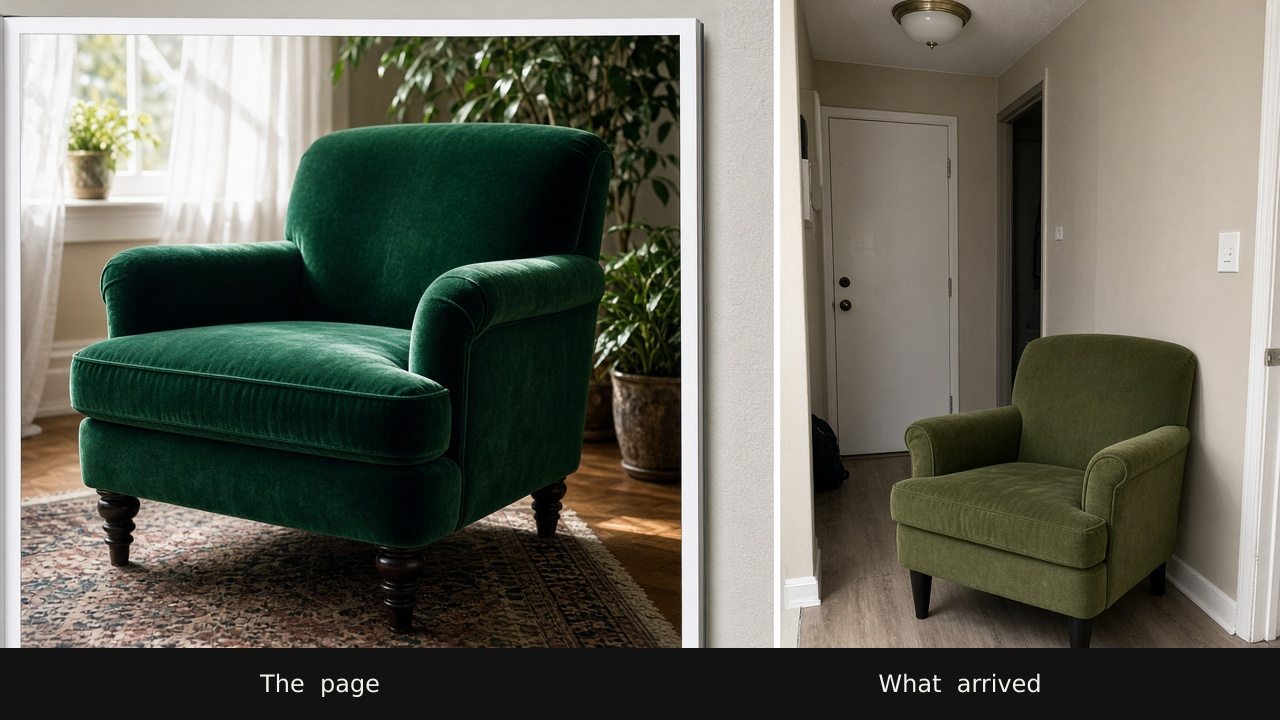
The product page is a promise. The box is the audit.
Every product page is a contract written in light.
Scale, color, finish, weight, how it sits in a room, how it sits on a face — the page asserts all of this, whether you meant it to or not.
A hero image is not decoration. It is a specification, delivered to someone who has no other way to check.
DataReportal's Digital 2025 report, using Statcounter, put mobile at more than 63% of global page requests in December 2024.
The most important object in your catalog is often being judged at the size of a postage stamp, in whatever light the bus happens to have.
Then the box arrives, and the audit begins.
Real size. Real color. Real material, under a kitchen bulb that was not in the shot.
There is no retouching in a hallway.
This is why "not as pictured" is the most expensive sentence in retail.
It does not mean the customer is difficult.
It means your most public document — the page — and your most private one — the object — do not agree.
Photography can lie by being too kind: a wide lens that slims a chair, a gel that warms a cream, a crop that hides how tall the thing actually is.
Rendering can lie by being too perfect: a digital twin that has never been cheapened by a production change, a material that has never been substituted, a shade that exists in the file and not in the batch.
Both can also tell the truth, which is the entire point.
The craft is not making the image beautiful.
The craft is making the image accountable.
Beauty already knows. Furniture is learning.
If you sell foundation, you already live inside this problem.
A half-shade miss is not a preference. It is a refund.
The industry spent a decade throwing samples at it, then another few years throwing filters at it, and the honest ones will tell you the only thing that moves the number is letting someone see the product on themselves, in their light, before they pay.
Furniture is the same physics with heavier boxes.
You cannot sample a sofa. You can only show it — and if you show it without scale, without the customer's actual room, without the real cloth under a real window, you are asking them to take a several-hundred-euro leap of faith.
A meaningful share will leap. A meaningful share will leap back.
DHL already told you the size problem is not a niche complaint.
The tools that close that gap are not mysterious.
Interactive 3D that is actually the SKU, not a cousin.
AR that puts the object in the room it has to live in.
Shade try-on that maps to a real undertone, not a flattering average.
Variant imagery that is the variant — not the hero color with a swatch.
What the tools do, when people actually use them, is measurable — and smaller, and more honest, than the vendor decks.
Shopify reports that Gunner Kennels cut returns 5% after letting shoppers place a life-size crate next to the dog.
That is a named brand, a named metric, and a VP on the record.
We will not dress it up as "25–40%."
A configurator nobody opens is still a very expensive ornament.
Accuracy without adoption is a press release.
Stop managing returns. Start reading them.
Here is the useful reframe, and it costs nothing to adopt.
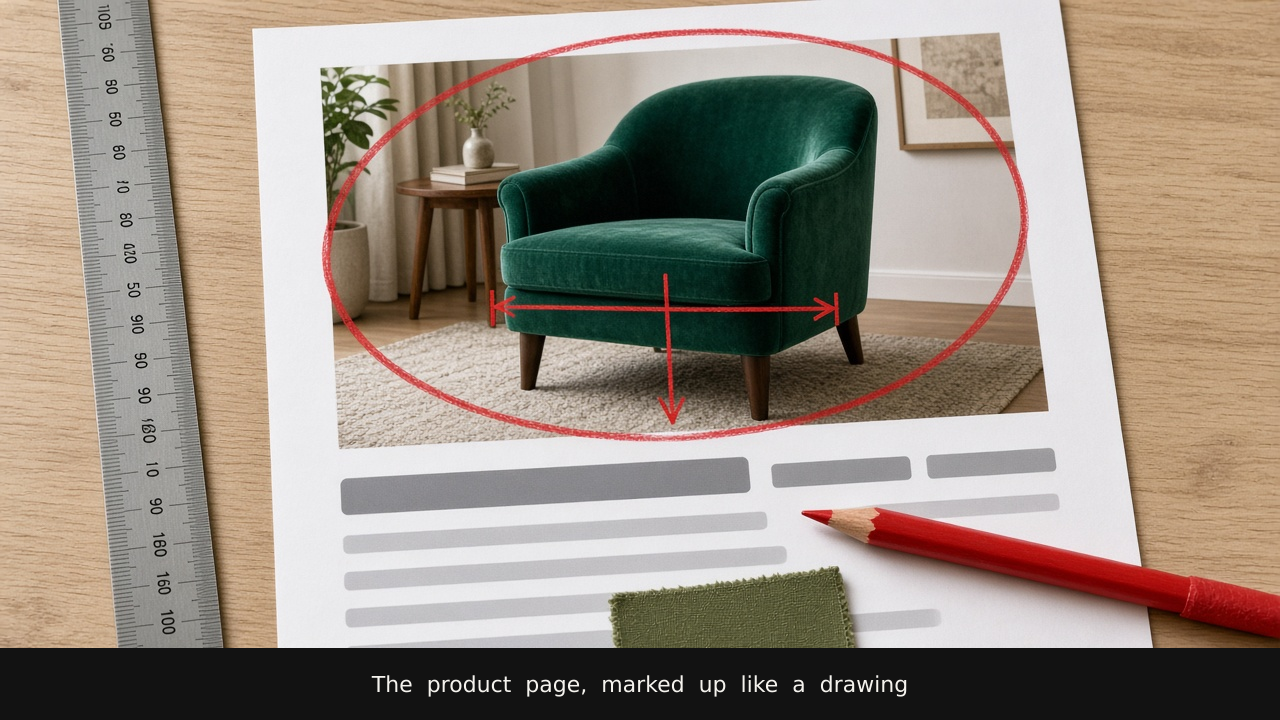
Treat every return reason as a ticket against the product page.
"Too small" is not a warehouse note. It is a scale failure in the gallery.
"Wrong color" is not a moody customer. It is a lighting and material failure.
"Not as pictured" is the page, in so many words, failing its only job.
The brands that get this do a few unglamorous things on purpose:
- They make the digital twin match the physical one — including the production substitutions, the cheaper lining, the shade that drifted. A beautiful lie converts once and returns forever.
- They show scale in the customer's world, not theirs. A person, a doorway, a phone placed on the seat. AR when the object has to fit a room. Try-on when it has to fit a face.
- They let the ugly questions get answered on the page. Dimensions in the units the customer thinks in. True color names, not poetry. What's in the box. What it weighs. What it is not.
- They watch the SKUs that come back, and they change the page before they change the policy. The highest-return items are not always the worst products. They are often the worst depictions.
- They do not hide behind a free return. Free is a courtesy. It is not a fix. A generous policy on a dishonest page is just a more expensive way to keep lying.
None of this is a guarantee. Representation is a craft, not a switch.
But it is a craft you can practice on purpose, and the alternative is funding a reverse-logistics company with your own catalog.
How we think about it at BuonaLabs
We treat the product page as a specification, not a mood board.
That means building the digital object so it can stand in for the physical one — accurate materials, honest scale, every variant from the same source of truth — and then putting that object to work: stills, 3D, AR, the try-on, the configurator.
Photography stays where human warmth belongs.
The goal is not a prettier catalog. It is a page a customer can trust enough that the box does not become a courtroom.
A return is the most expensive usability test you will ever run.
The subject paid for the privilege. The findings are already in your warehouse.
The only question is whether you read them as a cost — or as a brief.
Sources
https://nrf.com/media-center/press-releases/consumers-expected-to-return-nearly-850-billion-in-merchandise-in-2025
https://nrf.com/research/2025-retail-returns-landscape
https://www.optoro.com/returns-blog/returns-unwrapped-comparing-retailer-shopper-perspectives/
https://www.dhl.com/global-en/microsites/ec/ecommerce-insights/insights/e-commerce-logistics/2025-returns-trends.html
https://doi.org/10.1007/s11573-021-01032-1
https://datareportal.com/reports/digital-2025-global-overview-report
https://www.shopify.com/blog/ar-shopping
BuonaLabs is a digital innovation studio in Lübeck, Germany, building product pages, digital twins, and commerce experiences that try to tell the truth about the object. If your most expensive reviews are arriving in boxes, let's talk.