

What to Automate, What to Keep Human

The honest 2026 playbook for AI agents — why roughly 40% of projects get scrapped, and the one question that separates the wins from the wreckage.
There is a sales pitch being made to every business owner alive right now, and it goes like this: point an AI agent at your messiest, most repetitive work, and watch it disappear.
Eighty percent automation. Minimal oversight.
A digital workforce that never sleeps.
It's a seductive promise.
It's also, for most companies that buy it wholesale, the beginning of an expensive lesson.
The technology is real and the productivity is real — we use these tools every day and they're remarkable.
But "automate everything" is not a strategy; it's how you end up in a statistic.
The companies winning with AI in 2026 aren't the ones automating the most. They're the ones who got ruthlessly clear about a single question: where does the human stay?
The reality check nobody puts in the brochure
Start with the numbers, because they're sobering.
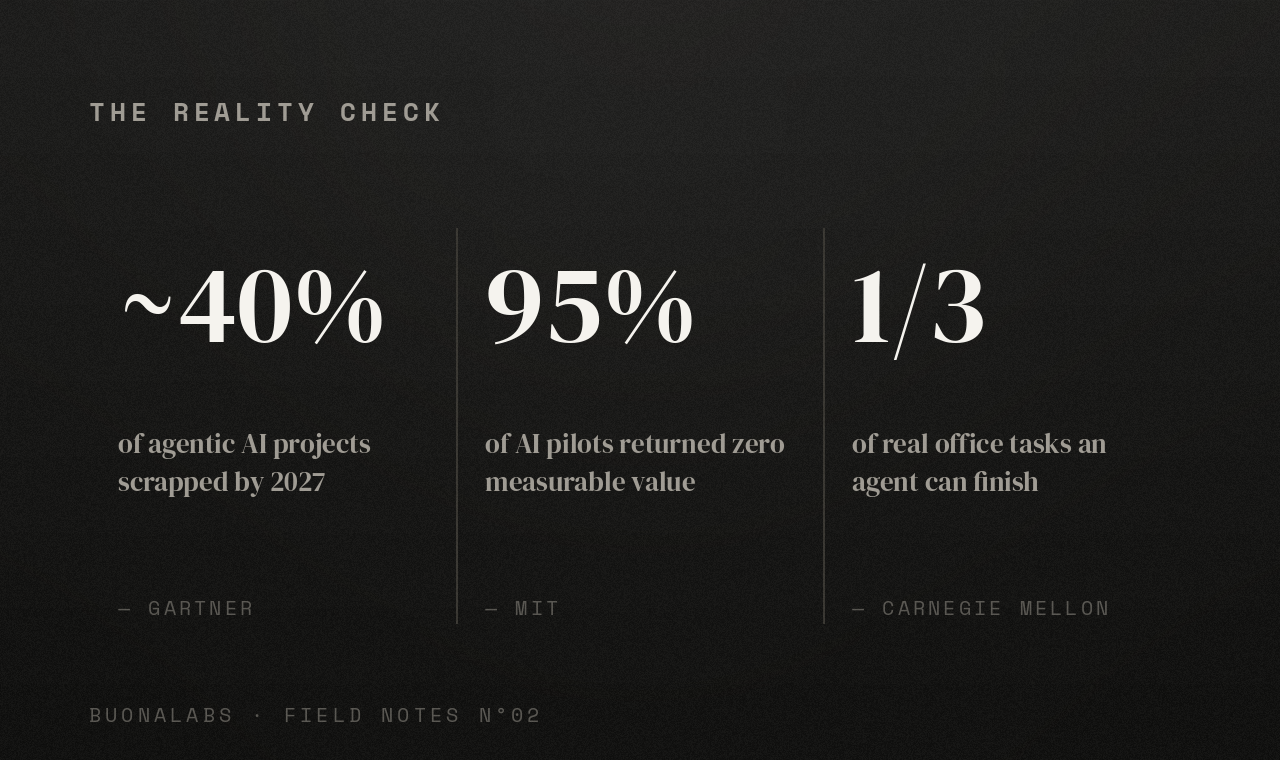
Gartner projects that more than 40% of agentic AI projects will be scrapped before the end of 2027.
MIT research found that around 95% of enterprise AI pilots delivered zero measurable financial return. And when Carnegie Mellon built a benchmark of real office tasks, the best available agents completed barely a third of them.
This is not a story about bad technology. It's a story about misapplication.
The projects die for boringly consistent reasons: costs that balloon past the original estimate, business value that never quite materializes, and risk controls that were treated as an afterthought.
The pitch promised 80% automation with light supervision — and that promise simply does not survive contact with a real production environment, where "autonomous" workflows turn out to need constant human adjustment, integration with legacy systems is harder than anyone budgeted for, and somebody still has to validate what the machine did.
The lesson isn't "don't automate." It's "don't believe automation is free, binary, or unsupervised."
A cautionary tale, and why it matters
You don't have to imagine how this goes wrong.
Klarna very publicly celebrated replacing hundreds of customer-service roles with an AI agent — and then, just as publicly, had to walk parts of it back when the system started producing outcomes the business couldn't stand behind.
They are not alone, and they're not foolish; they're early.
The deeper failure in cases like these is almost always the same: the agent had no reliable way to recognize when it was out of its depth.
In one widely discussed incident, an airline's rebooking agent kept confidently making bookings during a storm even as the situation outran its understanding — because it was optimizing for speed, not accuracy, and had no mechanism to notice its own reasoning had degraded and hand back to a person.
That capability — call it knowing when to tap a human on the shoulder — is the entire ballgame.
An agent that fails loudly and escalates early is an asset.
An agent that fails silently and confidently is a liability wearing a productivity costume.
Stop asking "can we automate this?"
That's the wrong question, because the answer is almost always yes.
Can you automate it is a technical question.
Should you, and how much, is a business question — and it's the one that actually protects you.
It helps to think of autonomy as a dial, not a switch.
At the low end sits confirmation mode: the agent does the legwork but pauses for a human to approve anything consequential.
In the middle, sandboxed autonomy: the agent runs freely, but only inside hard limits — specific tools, a capped budget, a time box.
At the far end, open autonomy: the agent runs for long stretches with little oversight.
Here's the rule that matters: the further you turn that dial up, the more value an agent can create — and the higher the failure rate, the harder the engineering, and the more governance you need.
Most production disasters in 2026 happen because a team designed for the autonomy level they wanted, not the level their systems and data could actually support.
Match the dial to reality, not ambition.
The test: a simple way to sort the work
Run every candidate task through two lists.
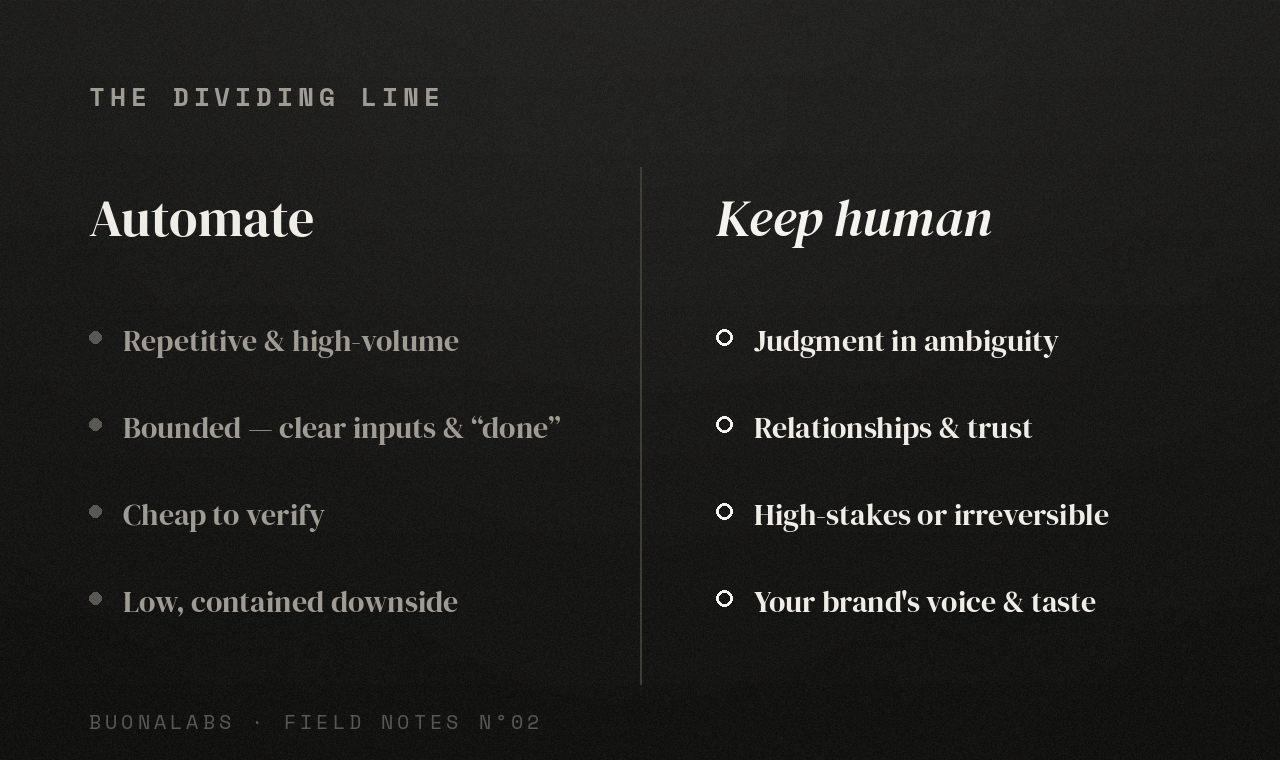
Strong candidates to automate share four traits.
They're repetitive and high-volume.
They're bounded — clear inputs, clear definition of "done."
They're verifiable — you can check the output cheaply.
And the downside is contained — a mistake is annoying, not catastrophic.
Think: drafting first-pass responses, reconciling data between systems, monitoring for anomalies, status tracking, routing and triage, summarizing long documents for a human to act on.
Keep these human — at minimum at the decision point.
Anything requiring judgment in ambiguity.
Anything built on relationships and trust.
Anything high-stakes or irreversible — money out the door, legal commitments, anything touching safety.
Anything that is your brand — the voice, the taste, the "no, that's not who we are." And anything where being wrong is expensive to discover later.
Notice the pattern.
The best designs don't choose between human and machine.
They let the agent do the tireless 80% of the gathering, drafting, and monitoring — and reserve the human for the 20% that's actually a decision.
That's not a compromise. That's the architecture that works.
If you operate in Europe, this is not optional
One more reason to be deliberate, and it's close to home for any business operating in the EU.
The EU AI Act's high-risk provisions take effect in August 2026, and if you're deploying agents in areas like finance, healthcare, insurance, or HR, you very likely fall under them.
That means mandated human oversight, transparency obligations, data-governance standards, and documentation you have to build in from day one — not bolt on later.
The penalties are not symbolic: up to €35 million or 7% of global annual turnover.
"Keep a human in the loop" stopped being just good engineering hygiene.
In a lot of cases, it's now the law — and designing for it from the start is dramatically cheaper than retrofitting it after an audit.
What the survivors do
The 60% of projects that make it share a recognizable shape, and none of it is glamorous:
They start narrow.
One specific, bounded, low-risk task where the value is measurable and the blast radius is small — then expand from proven ground.
They build governance first.
Scoped access, audit trails, spending and rate limits, and staged rollout are designed in, not patched on after the first incident.
They keep humans at the checkpoints.
Approval gates before anything consequential, and agents that escalate proactively when confidence drops.
And they measure honestly.
Not "we feel it's working," but hours of manual work removed, error rates moved, cycle times shortened.
If you can't name the number, you can't defend the project — and these days, your CFO will ask.
How we think about it at BuonaLabs
We're not here to sell you the most automation.
We're here to make sure you're in the 60%, not the 40%.
That means we design human + agent systems, not human-replacement fantasies. We start with the boring, bounded win that pays for itself, instrument it so the ROI is visible from week one, and put the human exactly where judgment, trust, and accountability live.
We turn the autonomy dial up only as fast as your systems, your data, and your risk tolerance actually allow.
Because the goal was never "automate everything."
The goal is a business that moves faster and still recognizes itself in the work.
Get the line right between machine and human, and AI becomes the best leverage you'll ever buy.
Get it wrong, and it becomes the most expensive thing you never needed.
The question isn't whether AI can do the work.
It's where you decide a person still has to.